Showing posts with label Science. Show all posts

March 3, 2014

In the Dark of the Night

The Milky Way... 

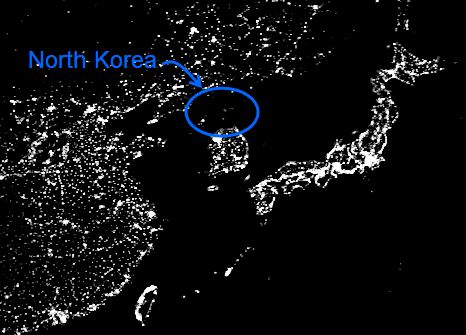
Have you ever seen it? Have you seen it recently? Will you ever see it again? In far too many places on this planet, particularly in the developed world, the glow of the stars and galaxies in the night sky is almost undetectable. All you can see are stars and planets too bright to be drowned out by man made light pollution. 


The lesser-developed areas of the world fair far better than most Americans when it comes to visualizing the awesome beauty of the unobscured night sky. This may be North Korea's one claim to superiority over its neighboring cousins.


The adverse effects of artificial light include sky glow, glare, light trespass, light clutter, decreased visibility at night, and energy waste. Light pollution is not only a hinderance to astronomy, but it also impacts us directly. There is strong evidence that excessive nighttime light exposure has a connection to cancer in humans. Light pollution also has been determined to adversely affect wild animals, birds and beneficial insects.  

There is an organization dedicated to salvaging what can be from the blight of light. This is the International Dark-Sky Association (IDA). To date the IDA has established 10 Dark Sky Reserves worldwide. There are also Dark Sky Parks, six of which are in the United States. The most recent addition is a 600 acre preserve of old growth timber in Emmet County, Michigan. The Headlands Dark Sky Park is south of Macinaw City in the northernmost reaches of Lower Michigan, very near the Straits of Mackinac.

Manmade light pollution is problem on so many fronts, not the least of which is the loss of awe, wonder and curiosity in the children. The night sky has inspired marvels ranging Copernican astronomy, Galileo's telescope, Heinrich Olbers' paradox, Kepler's three laws, Van Gogh's Starry Night Over the Rhone, Asimov's Nightfall to Sagan's Cosmos. We sent men to the moon with that awe and wonder in our hearts, and we still dream of travelling to the stars. What is going to happen when whole generations of inner city kids lose that wonder?


###

November 9, 2013

We'll keep working on it

He would have been 79 years old today. 

The video comes from episode 8 of the too-short running series, Cosmos, which aired November 16, 1980. Sagan's dreams are inspiring, and some on this planet still work and hold out hope that humanity will survive this age of fear, selfishness, and nationalism... and that we, our children or our great grandchildren will some day find the stars. 

 While there is abundant wealth and technology... and in spite of persistent efforts by anti-intellectuals and the purveyors of superstitious myth, human intellect survives... but it is in our compassion where we fall short. Humanity seems to grow thinner by the day. 

 We'll keep working on it. Happy birthday, Carl.

###

October 22, 2013

October 21, 2013

They killed Clyde


20 years ago today Congress positively proved that bipartisanship is not always a plus, when 26 Democrats joined 31 Republicans to defund our gutsiest scientific endeavor since Alan Shepard rocketed into near Earth orbit 32 years earlier.

The Swiss thank us for this.


###

October 4, 2013

The Real Miracle Workers

Vitaly Ginzburg: 1916–2009

Vitaly Ginzburg was one of the most significant theoretical physicists of the 20th century. Ginzburg was born this day in 1916 and died on Sunday November 08, 2009 at the age of 93. He had been ill for some time and had been hospitalized for more than a month before his death.

Ginzburg was born in Moscow on October 04, 1916 into a Jewish family. He had a relatively short primary education, only starting school at age 11 and leaving four years later in 1931 to work as a technician in an X-ray laboratory at a local higher-education technical institute. It was here that his interest in physics first began, sparked by popular-science books such as Physics in Our Day (not in print in English) by the Russian physicist Orest Danilovich Hvolson.

Ginzburg joined Moscow State University in 1933, graduating five years later with a degree in physics. He then began a PhD, which he completed in 1940, taking just two years instead of the usual three. Ginzburg immediately joined the P N Lebedev Physical Institute of the Soviet Academy of Sciences, which, the following year, after the Soviet Union entered the Second World War, was moved to the city of Kazan in central Russia. Ginzburg obtained a DSc in 1942.

Although Ginzburg started out as an experimental physicist in the field of optics, he eventually realized that his talents were as a theorist and went on to work in many different areas of physics and astrophysics. In 1950, for example, he developed with Lev Landau a partially phenomenological theory of superconductivity. He also studied how electromagnetic waves propagate through plasmas, such as the ionosphere, developed a theory of the origin of cosmic radiation, and worked on the superfluidity of helium II.

"To me, the special charm and specific feature of theoretical physics is that you can quickly change what you are studying," said Ginzburg in an interview with physicsworld.com published a week before his death. "Typically, you do not need many years to build new equipment, as experimentalists often do. Having said all that, I think that my biggest achievement in physics is connected with the theory of superconductivity."

Ginzburg shared the 2003 Nobel Prize for Physics with Alexei Abrikosov and Tony Leggett for their joint work on the theory of superconductors and superfluids. Ginzburg’s work on "type-II" superconductor, or materials in which superconductivity and magnetism co-exist enabled the discovery. Type-II superconductors differed significantly from type-I superconductors, which repel magnetic fields.

In 1971 Ginzburg was appointed head of the theoretical department at the Lebedev, where he stayed until retiring in 1988. Even in retirement he continued giving his famous weekly seminars as he had done since the 1950s. In 1998 Ginzburg took over as editor-in-chief of the scientific journal Uspekhi Fizicheskikh Nauk – a position he held until his death.

A staunch atheist, Ginzburg was critical in later years of the growing influence of the church in Russian secular education. He particularly disliked the church pushing creationism as the foundation of science, although he maintained that religion was a fundamental human right. "But I am convinced that the bright future of mankind is connected with the progress of science," he said in his interview with physicsworld.com, "and I believe it is inevitable that one day religions (at least those existing now) will drop in status to no higher than that of astrology."


###

September 18, 2013

The real miracle workers

Jean Bernard Léon Foucault
September 18, 1819 – February 11, 1868


Léon Foucault was a French physicist best known for the invention of the Foucault pendulum, a device demonstrating the effect of the Earth's rotation.

Foucault was the son of a Parisian publisher from whom he received his early education. Later he studied medicine but discovered he was afraid of blood and abandoned that endeavor in favor of physics.

Foucault next directed his attention to the improvement of L. J. M. Daguerre's photographic processes. For three years he served as experimental assistant to Alfred Donné (1801–1878) in his course of lectures on microscopic anatomy.

With A. H. L. Fizeau he carried out a series of investigations on the intensity of the light of the sun, as compared with that of carbon in the arc lamp, and of lime in the flame of the oxyhydrogen blowpipe; on the interference of infrared radiation, and of light rays differing greatly in lengths of path; and on the chromatic polarization of light.

In 1850 Foucault conducted an experiment using the Fizeau–Foucault apparatus to measure the speed of light; it came to be known as the Foucault–Fizeau experiment, and was viewed as "driving the last nail in the coffin" of Newton's corpuscle theory of light by demonstrating that light travels more slowly through water than through air.


In 1851 Foucault provided the first experimental demonstration of diurnal motion, or the rotation of the Earth on its axis. He achieved this by showing the rotation of the plane of oscillation of a long and heavy pendulum suspended from the roof of the Panthéon in Paris. The experiment caused a sensation in both the learned and popular worlds, and "Foucault pendulums" were erected and displayed in major cities across Europe and America. 

A year later he performed a conceptually simpler demonstration using a gyroscope, which he did not invent but is credited with naming. In 1855 Foucault received the Copley Medal of the Royal Society for his "very remarkable experimental researches". Earlier in the same year he was installed as physicien (physicist) at the imperial observatory at Paris.

In 1855 Foucault discovered that the force required for the rotation of a copper disc becomes greater when it is made to rotate with its rim between the poles of a magnet, the disc at the same time becoming heated by the eddy current or "Foucault currents" induced in the metal. In 1857 Foucault invented the polarizer which bears his name, and a year later devised a method of testing the mirror of a reflecting telescope to determine its shape. The "Foucault knife-edge test" allows the worker to tell if the mirror is perfectly spherical or has non-spherical deviation in its figure.

Prior to Foucault's publication of his findings the testing of reflecting telescope mirrors was a "hit or miss" proposition. Foucault's knife edge test determines the shape of a mirror by finding the focal lengths of its areas, commonly called zones and measured from the mirror center. The test focuses light point source at the center of curvature and reflected back to a knife edge. The test enables the tester to quantify the conic section of the mirror, thereby allowing the tester to validate the actual shape of the mirror, which is necessary to obtain optimal performance of the optical system. The Foucault test is still used today, most notably by amateur and smaller commercial telescope makers as it is inexpensive and uses simple, easily made equipment.

In 1862, using Charles Wheatstone’s revolving mirror, Foucault determined the speed of light to be 298,000 km/s (about 185,000 mi./s) —10,000 km/s less than that obtained by previous experimenters and only 0.6% off the currently accepted value. 

That same year Foucault was inducted as a member of the Bureau des Longitudes and an officer of the Légion d'Honneur. In 1864 he was made a member of the Royal Society of London, and the next year a member of the mechanical section of the Institute. 

In 1865 Foucault's papers on a modification of Watt's governor appeared. Foucault had for some time been experimenting with the generator hoping to make its period of revolution constant. He was simultaneously working on a new device for regulating the electric light, and showed how the sun could be viewed without injuring the eye. 

Near the time of his death he returned to the Roman Catholicism that he previously abandoned. Foucault was buried in Paris in the Cimetière de Montmartre. The asteroid 5668 Foucault is named for him, and his name is one of the 72 inscribed on the Eiffel Tower.

###

September 11, 2013

The real miracle workers

Jacinto Convit García

September 11, 1913 -- May 12, 2014


Jacinto Convit García is a Venezuelan scientist and decorated medical researcher best known for the development of a leprosy vaccine. Born in Caracas, Venezuela on this date 100 years ago the son of a Spaniard with Catalonian roots and a Venezuelan mother with Canarian roots.

Dr. Convit began his studies in the Caracas School and continued in the Andrés Bello lyceum. In 1932 he entered to the Medicine school of the Central University of Venezuela where 1938 he earned his title as a Medical Science Doctor, graduating with honorifics in physics, human anatomy, descriptive and topographic anatomy, Clinical Medicine and clinical surgery. 

In 1987, he received a Prince of Asturias Award in the Scientific and Technical Research category. Dr. Convit has been awarded with over 40 Orders of Honor from several domestic and numerous international universities.  

Dr. Convit's works are known and recognized internationally. The Bio-Medicine institution receives fellows sent by the WHO/PAHO from America, Africa and Asia. In 1971 Dr. Convit was named by the WHO as Director of the Co-operative Centre for the Study and Histological Classification of Leprosy, a position that he still holds.

This giant of medical science labors in relative anonymity at the laboratory he has called home for many years, almost unrecognized as the physician who saved thousands from the ravages of leprosy. At 100 years old Dr. Convit continues his work in search of a vaccine to prevent cancer. 


###

August 26, 2013

The real miracle workers

Albert Sabin
August 26, 1906 -- March 3, 1993

"A scientist who is also a human being cannot rest while knowledge which might be used to reduce suffering rests on the shelf..."


Albert Bruce Sabin was born Aug. 26, 1906, in Bialystok, Poland, then a part of Imperial Russia. His family immigrated to the United States in 1921 to escape the persecution of Jews.

He attended high school in Paterson, N.J., after taking a six-week cram course in English from two cousins. After graduation from high school he first planned a career in dentistry because an uncle, a dentist, offered to finance his college education if he would enter that profession. Dr. Sabin said years afterward that he studied dentistry for three years and then "couldn't stand it any longer" because he had become captivated by the possibilities of medical research.

 He graduated from New York University in 1928. With the aid of scholarships, fellowships and odd jobs, he attended the university's medical school and, while there, found time to do research on pneumococcus bacterial infections. He was awarded an M.D. degree in 1931. That summer, a polio epidemic in New York influenced his choice of a research career on polio and other infectious diseases of the human nervous system.

Before entering full-time research in that field, however, he trained in pathology, surgery and internal medicine at Bellevue Hospital, through 1933. He spent the next year in research at the Lister Institute of Preventive Medicine in London. In 1935 he returned to New York to join the research staff of the Rockefeller Institute for Medical Research, now Rockefeller University. In 1939 Dr. Sabin moved to the University of Cincinnati and its Children's Hospital Research Foundation to conduct research on viruses.

After the United States entered World War II, Dr. Sabin became a consultant to the Army on viral diseases. Later, as a lieutenant colonel in the Medical Corps, he studied diseases affecting American troops throughout the world. He isolated the virus that caused sandfly fever, a nonfatal epidemic disease that was causing illness among troops in Africa. 

Later he showed that an ordinary mosquito repellent would provide protection against the infection by warding off the insects that carried the disease. He helped develop a vaccine against dengue fever, a debilitating but usually nonfatal disease that was striking many troops in the South Pacific. 

He also studied the parasites that cause toxoplasmosis, as well as the viruses that cause encephalitis, inflammations of brain tissue. Late in World War II, a vaccine he had developed against Japanese encephalitis virus was given to about 70,000 American troops preparing for the invasion of Japan. 

A decade after the war, Dr. Sabin was the first to identify a virus called echo 9 as a cause of human intestinal illness. At the end of the war, Dr. Sabin returned to the University of Cincinnati to continue work on polio. He developed a live-virus vaccine that was first tested in 1954. 

By that time, however, the killed-virus polio vaccine developed by Dr. Salk had already been developed, tested and was being put into use. Public health experts in the United States decided the Sabin vaccine should be given its first major trials abroad, so that people already protected by the Salk vaccine could not be accidentally included in the studies and thus confuse the results. 

 In this country, the Sabin vaccine was first used on a large scale in 1960 in Cincinnati, where it was given to 180,000 schoolchildren. Two years later all three constituents of the vaccine, one against each of the three major polio virus types, were licensed by the United States Public Health Service. 

 Whereas the Salk vaccine had to be given by injection and required later booster shots to insure long-term immunity, the Sabin live-virus vaccine could be taken by mouth and provided lifetime protection against polio. Moreover, the harmless virus of the vaccine seemed to be "catching": It spread beyond the recipients to protect even some people who had not received the vaccine at all.

Dr. Sabin was elected to the National Academy of Sciences in 1951 and received numerous other honors, including the Bruce Memorial Award of the American College of Physicians in 1961, the Feltinelli Prize of the Accademia dei Lincei of Rome in 1964, the Lasker Clinical Science Award in 1965 and the United States National Medal of Science in 1971. Throughout his long career he was noted for diligence, hard work and long hours as well as brilliance in research.

###

March 12, 2013

Reminiscent of a story I heard somewhere

Makes you wonder if the shoe is on another foot these days.

Additional bands of locusts entered Israel throughout the day on Tuesday, marking a week since the first wave of bugs flew across the Sinai border and landed here.


On the first day of Shevat a plague of locusts descended upon Pharaoh's land (Exodus 10:1–20), devouring everything that was left that the hail did not take. Too bad the Egyptians didn't have aerial spraying available in 1400 BCE. Seems science and modern technology might pull this one out for God's original bible pounders. 

###

February 12, 2013

February 9, 2013

Epimenides' Paradox


"All Cretans are liars"

Epimenides
A Cretan Liar?
Or so the philosopher and poet Epimenides of Knossos (6th century BCE) is reputed to have once uttered. The statement is considered a paradox because Epimenides was himself a resident of the Isle of Crete. If all Cretans are liars then the statement itself would be a lie... or that at least one Cretan is not a liar. This statement would be true only if it was false.

There is biblical reference to Epimenides and this particular paradoxical declaration... albeit one that indicates Paul the Apostle seriously misunderstood the nature of the statement.

600 years after Epimenides was dead and buried, writing in Titus 1:12, Paul is quoted as saying "even one of their own prophets has said, 'Cretans are always liars, evil brutes, lazy gluttons.' This testimony is true." Paul obviously considers Epimenides’ to be denouncing his own people, and Paul himself agrees with that low opinion. He was apparently upset with the Cretans obstruction of Titus in his mission to the island.

Like most all of the Bible, Paul misses the point and displays classic religionistic ignorance. Epimenides was not derogating his tribe… he was attempting to demonstrate logical antinomy.

Math and science… baffling the faithful for 6,000 years.

###

January 28, 2013

Neil DeGrasse Tyson

... on why humankind needs science, and why government is particularly well suited for funding research.

"You can take a dollar and cut off this edge but don't get into the ink," he said. "Then cut off the other edge and don't get into the ink. Those two amounts of this dollar, that's the R&D budget of the United States. 

The rest is everyone complaining that our economy is losing ground in the world."

###

December 31, 2012

Making a difference

All of the blogs, e-zines, television news and discussion forums are recapping the notable deaths of this past year. Almost all of these seem to be focusing on sports and entertainment celebrities. I thought I'd do a little obit piece for the also-rans... the people who died this year who made a difference that will last longer than the celluloid... most of whom you've never heard of.


Arfa Karim Randhawa, world’s youngest Microsoft certified professional, died at age 16 in January from respiratory arrest resulting from an epileptic seizure. This Pakistani girl was a young computer genius who became the world’s youngest Microsoft Certified Professional at age 9. Bill Gates was so impressed with her smarts that he invited her to visit Microsoft’s U.S. headquarters in 2004. Among her words of wisdom spoken to reporter Todd Bishop: “If you want to do something big in your life, you must remember that shyness is only the mind. If you think shy, you act shy. If you think confident you act confident. Therefore never let shyness conquer your mind.”


F. Sherwood Rowland, Chemist, died at 84 in March. Rowland was groundbreaking researcher who was recognized by the 1995 Nobel Prize in chemistry. In 1974 he and his team discovered that chlorinated fluorocarbons, or CFCs, were damaging the ozone layer. The findings were met with skepticism by the scientific community. Rowland did not shrink from speaking out on the potentially catastrophic consequences of ozone depletion, and he strongly advised politicians and activists to push for a ban on CFCs. Today's discussions of climate change could use more voices like his.


Jack Tramiel died at 83 in April. Tramiel founded Commodore International and in 1982 released the Commodore 64. The little home computer became one of the most popular of all time, selling nearly 17 million units between 1982 and 1994. Born 1928 to a Jewish family in Lodz, Poland, he survived Auschwitz concentration camp and in 1947 emigrated to the U.S. Tramiel claimed that after surviving the Holocaust he could survive just about anything. He purchased chip manufacturer MOS Technology and Atari Corp. from Time Warner Communications.


Sam Porcello was the food scientist who died at 76 in May. Known as “Mr. Oreo,” the 34-year Nabisco veteran held five patents directly related to the Oreo, with the most famous being for the crème filling. As a member of the Nabisco R&D team he was really considered an expert on cocoa, but Porcello also created healthy snacks, including Snackwells products.


Sally Ride, Ph.D., Educator, Astronaut and Physicist died July 23, 2012 at the age of 61, following a 17-month battle with pancreatic cancer. beat out 1,000 other applicants for a spot in the National Aeronautics and Space Administration's (NASA) astronaut program. She went through the program’s rigorous training program and got her chance to go into space and the record books in 1983. After NASA, Sally Ride became the director of the California Space Institute at the University of California, San Diego, as well as a professor of physics at the school in 1989. In 2001, she started her own company to create educational programs and products known as Sally Ride Science to help inspire girls and young women to pursue their interests in science and math. 

Ride received many honors, including the NASA Space Flight Medal and the NCAA’s Theodore Roosevelt Award. She was also inducted into the National Women’s Hall of Fame and the Astronaut Hall of Fame. Although Sally Ride never publicly stated that she was a lesbian, her official obituary states she was in a 27-year relationship with Dr. Tam O’Shaughnessy, a woman. She will always be remembered as a pioneering astronaut who went where no other woman had gone before.


Robert Ledley, the inventor of the full-body CT scanner, died at age 86 in July. Ledley’s first career was as a dentist, but later became a biomedical researcher. He is credited as a pioneer in the use of computers in the healthcare field. Ledley founded the nonprofit National Biomedical Research Foundation in 1960 to promote the use of computers in biomedicine. His work was recognized with introduction into the National Inventors Hall of Fame in 1990 and with a National Medal of Technology in 1997.


William Moggridge died in September at age 69. In the late 1970s while with a company called Grid Systems Moggridge came up with the clamshell design used for laptop computers. The $8K, 12-pound device, quite portable for its time, gained prominence through NASA and military use. One of Moggridge’s claims to fame was coining the term “interaction design,” referring to the common sense idea that software and hardware should fit people’s needs. “If there’s a simple, easy principle that binds everything together, it’s probably about starting with the people.”


Norman “Joe” Woodland created the bar code (along with Bernard “Bob” Silver) while at Drexel University. He died in December at age 91.  He used his knowledge of Morse Code to come up with a technology that is used five billion times every day. In 1992, Woodland received the National Medal of Technology, and in a more modern tribute to Woodland and Silver’s work, Google introduced a Google Doodle atop its search page in 2009 recognizing the 57th anniversary of the patent.


###

December 24, 2012

A video tribute to Carl Sagan

A Universe Not Made For Us is the first of a 26-part series dedicated to the life and works of Carl Sagan.


A Universe Not Made for Us
Video by Callum Sutherland

“     Our ancestors understood origins by extrapolating from their own experience. How else could they have done it? So the Universe was hatched from a cosmic egg, or conceived in the sexual congress of a mother god and a father god, or was a kind of product of the Creator’s workshop—perhaps the latest of many flawed attempts. And the Universe was not much bigger than we see, and not much older than our written or oral records, and nowhere very different from places that we know.

We’ve tended in our cosmologies to make things familiar. Despite all our best efforts, we’ve not been very inventive. In the West, Heaven is placid and fluffy, and Hell is like the inside of a volcano. In many stories, both realms are governed by dominance hierarchies headed by gods or devils. Monotheists talked about the king of kings. In every culture we imagined something like our own political system running the Universe. Few found the similarity suspicious.

Then science came along and taught us that we are not the measure of all things, that there are wonders unimagined, that the Universe is not obliged to conform to what we consider comfortable or plausible. We have learned something about the idiosyncratic nature of our common sense. Science has carried human self-consciousness to a higher level. This is surely a rite of passage, a step towards maturity. It contrasts starkly with the childishness and narcissism of our pre-Copernican notions.

And, again, if we’re not important, not central, not the apple of God’s eye, what is implied for our theologically based moral codes? The discovery of our true bearings in the Cosmos was resisted for so long and to such a degree that many traces of the debate remain, sometimes with the motives of the geocentrists laid bare.

What do we really want from philosophy and religion? Palliatives? Therapy? Comfort? Do we want reassuring fables or an understanding of our actual circumstances? Dismay that the Universe does not conform to our preferences seems childish. You might think that grown-ups would be ashamed to put such disappointments into print. The fashionable way of doing this is not to blame the Universe—which seems truly pointless—but rather to blame the means by which we know the Universe, namely science.

Science has taught us that, because we have a talent for deceiving ourselves, subjectivity may not freely reign.

Its conclusions derive from the interrogation of Nature, and are not in all cases predesigned to satisfy our wants.

We recognize that even revered religious leaders, the products of their time as we are of ours, may have made mistakes. Religions contradict one another on small matters, such as whether we should put on a hat or take one off on entering a house of worship, or whether we should eat beef and eschew pork or the other way around, all the way to the most central issues, such as whether there are no gods, one God, or many gods.

If you lived two or three millennia ago, there was no shame in holding that the Universe was made for us. It was an appealing thesis consistent with everything we knew; it was what the most learned among us taught without qualification. But we have found out much since then. Defending such a position today amounts to willful disregard of the evidence, and a flight from self-knowledge.

We long to be here for a purpose, even though, despite much self-deception, none is evident.

Our time is burdened under the cumulative weight of successive debunkings of our conceits: We’re Johnny-come-latelies. We live in the cosmic boondocks. We emerged from microbes and muck. Apes are our cousins. Our thoughts and feelings are not fully under our own control. There may be much smarter and very different beings elsewhere. And on top of all this, we’re making a mess of our planet and becoming a danger to ourselves.

The trapdoor beneath our feet swings open. We find ourselves in bottomless free fall. We are lost in a great darkness, and there’s no one to send out a search party. Given so harsh a reality, of course we’re tempted to shut our eyes and pretend that we’re safe and snug at home, that the fall is only a bad dream.

Once we overcome our fear of being tiny, we find ourselves on the threshold of a vast and awesome Universe that utterly dwarfs—in time, in space, and in potential—the tidy anthropocentric proscenium of our ancestors. We gaze across billions of light-years of space to view the Universe shortly after the Big Bang, and plumb the fine structure of matter. We peer down into the core of our planet, and the blazing interior of our star. We read the genetic language in which is written the diverse skills and propensities of every being on Earth. We uncover hidden chapters in the record of our own origins, and with some anguish better understand our nature and prospects. We invent and refine agriculture, without which almost all of us would starve to death. We create medicines and vaccines that save the lives of billions. We communicate at the speed of light, and whip around the Earth in an hour and a half. We have sent dozens of ships to more than seventy worlds, and four spacecraft to the stars.

To our ancestors there was much in Nature to be afraid of—lightning, storms, earthquakes, volcanos, plagues, drought, long winters. Religions arose in part as attempts to propitiate and control, if not much to understand, the disorderly aspect of Nature.

How much more satisfying had we been placed in a garden custom-made for us, its other occupants put there for us to use as we saw fit. There is a celebrated story in the Western tradition like this, except that not quite everything was there for us. There was one particular tree of which we were not to partake, a tree of knowledge. Knowledge and understanding and wisdom were forbidden to us in this story. We were to be kept ignorant. But we couldn’t help ourselves. We were starving for knowledge—created hungry, you might say. This was the origin of all our troubles. In particular, it is why we no longer live in a garden: We found out too much. So long as we were incurious and obedient, I imagine, we could console ourselves with our importance and centrality, and tell ourselves that we were the reason the Universe was made. As we began to indulge our curiosity, though, to explore, to learn how the Universe really is, we expelled ourselves from Eden. Angels with a flaming sword were set as sentries at the gates of Paradise to bar our return. The gardeners became exiles and wanderers. Occasionally we mourn that lost world, but that, it seems to me, is maudlin and sentimental. We could not happily have remained ignorant forever.

There is in this Universe much of what seems to be design.

But instead, we repeatedly discover that natural processes—collisional selection of worlds, say, or natural selection of gene pools, or even the convection pattern in a pot of boiling water—can extract order out of chaos, and deceive us into deducing purpose where there is none.

The significance of our lives and our fragile planet is then determined only by our own wisdom and courage. We are the custodians of life’s meaning. We long for a Parent to care for us, to forgive us our errors, to save us from our childish mistakes. But knowledge is preferable to ignorance. Better by far to embrace the hard truth than a reassuring fable.

If we crave some cosmic purpose, then let us find ourselves a worthy goal. 
— Carl Sagan (1934–1996)
Astronomer, astrophysicist, cosmologist, author, and popularizer of science

###

December 20, 2012

...on a mote of dust

It was 1990. Carl Sagan had argued mightily to get NASA to turn the Voyager I spacecraft around as it departed planetary confines for the vastness of space. Sagan wanted the camera pointed sunward just long enough to capture an image of our planet from the edge of our solar system.  


Voyager was 3.7 million miles from home. The photo, later titled "The Pale Blue Dot," depicts Earth as a small speck of light suspended in a sunbeam. Sagan wrote about it for a presentation given shortly after the photo was taken... speaking with words that fill the human mind with wonder and with perspective... in typical Sagan fashion. 

"We succeeded in taking that picture, and, if you look at it, you see a dot. That's here... That's home... That's us... 

On it, everyone you ever heard of, every human being who ever lived, lived out their lives. The aggregate of all our joys and sufferings, thousands of confident religions, ideologies and economic doctrines, every hunter and forager, every hero and coward, every creator and destroyer of civilizations, every king and peasant, every young couple in love, every hopeful child, every mother and father, every inventor and explorer, every teacher of morals, every corrupt politician, every superstar, every supreme leader, every saint and sinner in the history of our species, lived there on a mote of dust, suspended in a sunbeam.

The earth is a very small stage in a vast cosmic arena. Think of the rivers of blood spilled by all those generals and emperors so that in glory and in triumph they could become the momentary masters of a fraction of a dot. 

Think of the endless cruelties visited by the inhabitants of one corner of the dot on scarcely distinguishable inhabitants of some other corner of the dot. How frequent their misunderstandings, how eager they are to kill one another, how fervent their hatreds. Our posturings, our imagined self-importance, the delusion that we have some privileged position in the universe, are challenged by this point of pale light. 

Our planet is a lonely speck in the great enveloping cosmic dark. In our obscurity... in all this vastness... there is no hint that help will come from elsewhere to save us from ourselves. It is up to us. 

It's been said that astronomy is a humbling, and I might add, a character-building experience. To my mind, there is perhaps no better demonstration of the folly of human conceits than this distant image of our tiny world. To me, it underscores our responsibility to deal more kindly and compassionately with one another and to preserve and cherish that pale blue dot, the only home we've ever known." 

Four years later, the title of the photograph would be used by Sagan as the main title of his book, Pale Blue Dot: A Vision of the Human Future in Space, and would be used as he traveled the country and the world promoting understanding through the lens of science. The following is an excellent animated video clip in which Sagan's voice can be heard.


Two years after the book was published he would succumb to the ravages of pneumonia. Sagan had long suffered from the effects of myelodysplasia, and his death came as no surprise. He died with his beloved wife, Ann Druyan, by his side. 

Sagan's final book, The Demon Haunted World - Science as a Candle in the Dark, was nearing completion at the time of his death. Ann had been by his side helping put his final words to paper. Sagan died before the final chapter was completed. Ann Druyan finished it for  him. Sagan's final tome serves as just another reminder of the massive contributions this man has given humankind. Sagan's remains were buried at Lakeview Cemetery in Ithaca, New York.

-- Carl Sagan, November 9,1934 - December 20, 1996

###

September 19, 2012

Yeah... what he said

Alonzo Fyfe is a philosopher. Mr. Fyfe studied philosophy at Montana State University, Bozeman and then spent six years in graduate school at the University of Maryland, College Park. His primary focus is on ethics and moral philosophy.

Alonzo is atheist, and he writes the Atheist Ethicist blog, one of the top 30 (out of about 200,000) atheist blogs on the web, according to SocialRank.com. Though counted as an atheist blog, Fyfe points out that there is no such thing as 'atheist' ethics.

Alonzo doesn't write much on politics. His reasons for abstaining are pretty much the reasons MD&A concentrated on politics. We have differing opinions on the usefulness of my efforts.

Today, because someone asked, Mr. Fyfe shares a bit of ink on my favorite topic... and he does a most fine job parsing the problem. This is an excerpt...

"A couple of decades ago, there was a faction of the Republican Party that felt that it was very important to provide and support institutions that provided people with food, shelter, health care, security, and opportunities to live their lives as best they could. These were not government solutions - which were prone to corruption and bureaucratic inefficiencies. They were private solutions offered within a framework that guaranteed that people treated each other fairly and honestly and peacefully.

It is a faction that would look at Africa as a model of leftist aid and intervention where things have gotten no better in 30 years, and at China where the economy was freed up and hundreds of millions of people were lifted out if poverty, and say, "See! That is what I am talking about." It is a faction that would have celebrated the fact that hundreds of millions of people living in China had better access to health care, better access to education, more freedom, and opportunities than their parents thought possible. It would have told Democrats, "If you care about doing real good in the real world, that is how it is done."

It would not accuse Democrats as being evil or as wanting nothing but to destroy America. It would accuse Democrats as being naïve - as having good intentions but as failing to recognize that the good they are trying to do is being swallowed up by corruption and inefficient bureaucratic centralized planning.

That Republican faction probably still exists, but I have trouble seeing it.

Now, the Republican Party is the favorite of those who promote fantasy over reality. They deny the findings of science and, in doing so, promote policies that would may work in the fantasy world of their imagination, but that have no place in the real world.

I compare them to a person stepping out onto the street having faith that the truck heading their way does not exist. The person who steps out onto the street ignoring reality deserves what she gets. However, these reality-free Republicans insist on dragging the rest of us onto the street as well - and the effect on our children will be disastrous."

This is but a small clip. You should read the whole thing. It is a very eloquent and interesting disection of the reason I spend so much time shedding scorn on the Republican party... much to the chagrin of some of my close associates.

C'est la Vie.

###

August 27, 2012

Science Guy Bill Nye speaks to the adults

...and I sure hope our Texas State Board of Education is listening.


###

April 8, 2011

Hard-wired

In a study led by New York University psychology professor, Dr. David Amodio and published in the September 2007 edition of the Nature.com’s online journal, Nature Neuroscience, researchers considered the observation that political conservatives tended to be stuck in structured, persistent cognitive styles, while political liberals displayed greater ability to respond to complexity, ambiguity and novelty. The study found that greater liberalism was associated with heightened cognitive sensitivity to cues for altering habitual responses.

Then in the December 2010 edition of the same online journal, in a study led by Dr. Kevin Bickart of the Boston University School of Medicine, researchers found that amygdala volume correlated with the size and complexity of human social networks. Those with greater amygdala size had more friends, associated with people of more diverse background, and made social contacts more easily and more often.

On Thursday Cognitive neuroscientist Ryota Kanai of the University College London, in the journal Current Biology [membership restricted] and reported in The National Journal, published the results of another study; This one seemingly corroborating Dr. Amodio’s 2007 work.

“[P]olitical conservatives tend to have a larger right amygdala, a region involved in detecting threats and responding to fearful stimuli, whereas liberals tend to have a larger anterior cingulate cortex, an area that becomes active in situations involving conflict or uncertainty.”

###

March 29, 2011

Why America is no longer exceptional


This is one of the more damning reports I believe I’ve ever read.

“81 percent of seniors from our top fifty-five colleges and universities failed a test of basic U.S. history questions drawn from a national exam designed for high school seniors.  Only 22 percent knew, for example, that the words “government of the people, by the people, for the people” came from Lincoln’s Gettysburg Address.  If most American youngsters don’t learn about their nation’s history in the K-12 years, they are unlikely ever to learn about it.”

From a History News Network article. Read the whole story HERE.

The sad part about this is we don’t seem to ever learn that putting dogmatists in charge of educational content contributes to the decline of understanding and knowledge. Judging from recent ballot victories, this might be just what the majority of Americans want.

The discussion in this report is about history, but social studies and science are also under dogmatist attack. Witness a recent opinion piece in Forbes, another in the Palm Beach Post, and some of the work coming from the Texas SBOE.

I'm sorry. The people who vote Republican want conservative, but that is not what they are getting. The Republican party long ago married itself to the "social" conservatives, and those now make up the vast majority of the biggoted dogmatists who have floated to the top of the right wingnut cesspool.

I'm all in favor of fiscal conservatism, but that goal will remain unachievable so long as these science deniers and historical revisionists remain in power. Their brand of "conservatism" more resembles the dream of the Taliban than that of the Founders of our nation. 

###

July 26, 2010

New perspectives on the energy return on (energy) investment (EROI) of corn ethanol

This is the title of a new report published July 11, 2010 in the Journal of Environment, Development and Sustainability. The paper was written by David J. Murphy, Charles A. S. Hall and Bobby Powers of the College of Environmental Science and Forestry, State University of New York, Syracuse.

Over the past decade there has been considerable debate on corn ethanol, most focused on whether it is a net energy yielder. The argument is generally that “if the Energy Return on Investment (EROI) of corn ethanol is positive then it should be pursued.

This report concludes that corn ethanol is not sustainable, requiring more resources than it produces.

“In light of this work, we conclude that production of corn ethanol within the United States is unsustainable and requires energy subsidies from the larger oil economy”

Read the abstract HERE.

Read the Readers Digest condensed version HERE. Be sure to read the comments.
~~