Showing posts with label Conservatism. Show all posts

December 17, 2017

TELL ME AGAIN WHY AMERICA IS EXCEPTIONAL

... or The reason Christianity sucks

This will be kind of a hodgepodge tale of how European Christianity led to America being simultaneously admired and despised by the rest of the planet. I'll just be hitting the high points. You can follow the links or do your own research if you want to know more. We'll start out with the Myth of Christopher Columbus and work our way to the Bears Ears National Monument.


Chris Comes to America - Or does he?

Columbus was more or less a freelance bounty hunter of the 15th century. King Ferdinand and Queen Isabella, with the blessing of the Church, offered a bounty for anyone who would steal property from Spanish Jews and Muslims to hand over to the crown, and our daring young Chris was quite happy to oblige. It was the money obtained from that plunder that provided the funding for his explorations. With his pockets full of booty, three ships and about 90 crew, Chris set out looking for a new route to East Asia and India.

To give you a bit of insight into his character, while en route Columbus offered a reward of 10,000 Spanish Maravedis (about $540) for the first person who sighted land. That much money was huge, since it represented what the typical sailor would have earned in a year. One early morning on October 12, 1492, one of the crew shouted out from atop a mast that he had seen land. Indeed what the sailor had spotted was probably Watling Island in the Bahamas, which is where Columbus is recorded as making his first landfall. Columbus immediately reneged on the reward, claiming that he had seen it first.

Nice guy, eh?

In the process of attempting to approach the island, Columbus wrecked the Santa Maria. Local and friendly indigenous bands of Arawaks, Tainos and Lucayans witnessed the accident, swam out to the wreckage, rescued the sailors and Columbus, and then worked for hours saving their cargo. We know all this because Columbus kept very good records. He was so impressed with the friendliness of the native people that he claimed their land in the name of Spain and the Catholic Church, kidnapped local women and children for the entertainment of the crew, and enslaved the men to look for nonexistent gold. In his own journal he wrote:

“As soon as I arrived in the Indies, on the first Island which I found, I took some of the natives by force in order that they might learn and might give me information of whatever there is in these parts.”

So now we know the evil that was in the heart of a man for whom our Exceptional America has named a national holiday. 

On to the next chapter, skipping ahead about three centuries. 

In 1775 Thomas Johnson and some other British citizens convinced the Piankeshaw tribe to sell them some land in what is now Virginia. Johnson died and willed the land to his heirs. In 1818 a Scotsman by the name of William M'Intosh bought a bunch of land from the U.S. Congress, with about 11,000 acres of it being part of the land Johnson bought from the Piankeshaw. As you might guess, this pissed off the Johnson's heirs, so they sued M'Intosh. The Court ruled for M'Intosh because it was the Congress that made the sale. Johnson's heirs appealed to the SCOTUS, which upheld the lower court ruling. In Johnson v. M'Intosh (1823), Chief Justice John Marshall wrote in his opinion that "the United States earned the 'exclusive right…to extinguish [the Indians'] title, and to grant the soil.'" He further wrote that "...the Indians themselves did not have the right to sell property to individuals," and that "...M'Intosh's claim, which was derived from Congress, was superior to Johnson's claim, which was derived from the non-existent right of Indians to sell their land." 

So at this point you have to ask, why did the tribe not have the right to sell their ancestral lands? Well, Chief Justice Marshall had an explanation for that. The M'Intosh case was one of three such cases, collectively known as "the Marshall Trilogy." All were based on the Doctrine of Discovery.

This doctrine is not and never was a law. It is a legal construction built upon the Christian faith and dates back to the time when the Church needed to justify what Columbus had done to the natives of the Bahamas. In 1493 the Pope retrospectively issued a Papal Bull which in part states, "...any land not inhabited by Christians" was available to be discovered, claimed, and exploited by Christian rulers and declared that "the Catholic faith and the Christian religion be exalted and be everywhere increased and spread, that the health of souls be cared for and that barbarous nations be overthrown and brought to the faith itself." 

Charming.

Marshall applied the Doctrine according to the way that colonial powers laid claim to lands belonging to foreign sovereign nations during the Age of Discovery. Under it, title to lands lay with the government whose subjects traveled to and occupied a territory whose inhabitants were not subjects of a European Christian monarch. The doctrine has been primarily used to support decisions invalidating or ignoring aboriginal possession of land in favor of colonial or post-colonial governments. Our Exceptional America has used this doctrine as an excuse to violate a majority of the treaties it has made with the native peoples of this land.  


Fast Forward Two Hundred Years

In 1851 the Standing Rock Sioux reservation was created under the Treaty of Fort Laramie. The Standing Rock Sioux may sound familiar, and it should due to the debacle created when our Exceptional America violated the treaty by agreeing to allow the Dakota Access Pipeline to cross near reservation land without consulting the tribe. This set off a protest as the tribe was rightfully concerned about it's only access to clean water. As the tribe protested, peacefully for the most part, there was video shot of the pipeline construction company bulldozing ancient stone prayer sites near the pipeline. Then the same company brought in private security guards who unleashed dogs on the protesters, and when the dogs didn't deter them, the guards sprayed the protesters with Mace. Not to be outdone, North Dakota Governor Jack Dalrymple first brought in water cannons, dousing the protesters with water on a frigid day, and then declared a state of emergency as an excuse for cutting off the protester's camp water source. In the end the protesters disbanded due to the oncoming, brutal winter. President Obama finally put a stop to the construction, but the current president gave the go ahead. Since that time the pipeline has lived up to the people's predictions, springing several leaks with the first coming before it was fully operational.

Less than a year later, in an unprecedented executive, that same president ordered the review of 40 national monuments created over the past 21 years, all on Indian land. The goal was obvious. He wanted to give the lands that were preserved for their beauty and for the native culture to those who would exploit the resource and defile the sacred ground. The current president called national monuments created by Obama as “an egregious abuse of power,” and said “It never should have happened. I am signing this order to end abuses and return control to the people,” when in fact, the action took the land back away from The People."

In an article appearing in the online edition, National Geographic writes, "Even in the face of Trump’s frenetic efforts to erase other parts of Obama’s legacy on multiple policy fronts, his call for ending abuse of monument designation stands out. No president has ever revoked a national monument named by a predecessor. No president has ever tried."


Just as when the 1851 and 1868 Treaties of Fort Laramie were broken, the reason for the shrinkage of Bears Ears is because of America's greed. Conservative Republican lawmakers have long argued that the federal government, which owns almost half the land in 11 western states, should turn control of much of it over to the states, or sell off parcels for commercial development and the allure of new jobs. In the black Hills the treaties were broken due to the discovery of gold. For Bears Ears it is the lure is coal and oil

When Obama created the monument in the waning days of his administration, Utah’s congressmen denounced Bears Ears as “a slap in the face” and “a travesty.” Rep. Rob Bishop, chairman of the House Natural Resources Committee, promised, in a website video, “We will fight to right this wrong.” With this president it was no fight. If Obama did it, he was going to undo it.

It is clear that Obama had the power to create national monuments on federal lands. That authority was written into law by the Antiquities Act, which was signed in 1906 by Theodore Roosevelt. With the exception of Reagan, every president since Teddy has used the law to designate national monuments. Obama created 34, which apparently rankles the current president.

His actions with Bears Ears will not be met with acceptance. There is still hope that we can put a stop to this latest violation of trust. Brad Sewell, a senior lawyer with the Natural Resources Defense Council, says “These are very popular places.”  He points out that “Many of our national parks started as national monuments. Even in Utah, where a fair amount of opposition is brewing in certain quarters, the public at large is in favor of national monuments.” Bears Ears is also home to more than 100,000 Native American archaeological and cultural sites, considered sacred by many tribes. This was Obama's primary reason for setting the land aside.

Disagreement over the Antiquities Act’s intent lies in its simplicity. The four-paragraph law clearly states that the president is authorized to “declare” national monuments. But the law says nothing about the presidential authority to do the reverse. “The Antiquities Act does not provide for rescinding a national monument,” says Robert Keiter, director of the University of Utah’s Wallace Stegner Center, and a specialist in public lands law. “The courts have not ruled on whether there is an implied power in the statute. The issue has never been litigated previously.”

There have been numerous Attorney General opinions arguing that the president lacks the power to revoke, with the most notable being authored by President Franklin Roosevelt’s attorney general in 1938. When FDR inquired if the Antiquities Act allowed him to scuttle a derelict Civil War-era fort in Charleston, South Carolina, as a national monument, he was advised it did not. Successive administrations heeded the same advice. This administration, having shown a disregard for precedent, public opinion, and the law, will attempt to once again show the contempt that this country has held the First People, and once again the People will rise up to meet the challenge. 

European Christianity has set the tone for the exploitation of the land and the disenfranchisement of a people. The natives may have been savages in the eyes of the old world, but the truth is that there has never in recorded history been so much savagery wreaked upon a people as was seen and is still being seen in this country. 

So tell me please... exactly why do we say that America is exceptional? If there was ever a time when this land was exceptional at anything, it was before the white Europeans brought their Christianity to these shores.

~~~~


October 1, 2017

Corporatism, Fascism, and Confirmation Bias

Franklin Delano Roosevelt’s had three Vice-Presidents during his four terms in office. Henry A. Wallace replaced John Nance Garner in 1941, and was replaced by Harry Truman in 1945. Of the three, Wallace was by far the most articulate in his condemnation of the corporatist agenda that was the Republican Party platform.
In 1944 Wallace penned an opinion piece that would be published in the April 9 edition of the New York Times. The Republicans have never ceased in that agenda, and Wallace's words of over 70 years ago lend perspective to why we find ourselves with the current president, and why his often otherwise reasonable supporters cling so ferociously to the lies that were drummed into their heads.

“The American fascists are most easily recognized by their deliberate perversion of truth and fact. Their newspapers and propaganda carefully cultivate every fissure of disunity…"


"American fascism will not be really dangerous until there is a purposeful coalition among the cartelists, the deliberate poisoners of public information, and those who stand for the K.K.K. type of demagoguery..."


The full piece, entitled The Danger of American Fascism, along with other of his works, may be found at the FDR Presidential Library & Museum website.


I doubt any of my biased Republican friends will read it, or anything that might disagree with what they want to believe, but who knows? They are not necessarily stupid... just confirmed in their bias.


~~~

January 3, 2015

Representative humanism

Listen to Mario Cuomo, you apathetic fools who could not find your way to the polls this past November, and learn a little about passionate humanism. You didn't bother to vote... and now as you watch the progressive gains of over 100 years circle the drain you should remember these words. 

Spend some time studying the issues. Learn a little of what Cuomo saw happening in the 80s and see if you don't find the same corporatist bullshit emanating from the bought and paid for mouths of the GOPers of today. When you start losing the gains progressives fought for in the early part of the last century... maybe in 2016 you can find a way to put down your video games and smart phones long enough to cast a vote. 


~~~

June 12, 2014

I am an American. The question is, are you?

My experience at the 2014 Texas GOP convention

Posted on June 11, 2014
By Heba Said

My heart palpitated with the unnerved feeling I had just from the thought of attending a Republican convention as a veiled Muslim woman.


It is not news that Republicans don’t seem to like Muslims. As close as the city of Keller, and as recently as last week, Trustee Jo Lynn Haussmann wrote on her Facebook page “SOUTH LAKE - Do you realize because SO FEW voters took the time and responsibility to VOTE in the municipal elections - YOU NOW HAVE A ‘MUSLIM’ on the City Council!!! What A SHAME!!!!!” 

The comments have since been deleted and referred to Southlake councilman Shahid Shafi. 

With influences such as Pamela Gellar and Pat Robertson, it is no wonder that Republicans are so easily associated with Anti-Islam sentiments, the instigation of Islamophobia and outright hatred toward Muslims.

After two days at the convention, the only emotions I could describe were anger and disappointment.

I attended the convention as a reporter hoping to tell readers about the panel discussions I attended, but I discovered a cult-like hatred that is simply disgusting.

As I walked through the halls, people stopped in their tracks and frowned and shook their heads at me. Panelists threw the word “Islamist” around as if it were perfectly OK, and one man even asked if I felt alone at a meeting. I was referred to as “you people” and “y’all Muslims” more times than I can count. The worst part was the way delegates looked at me, as if I were something to fear when I approached them.

The Muslim voter was disregarded completely in discussions on how to tackle politically engaging religious minority groups. So as a reporter, I asked, how the Republican party plans to reach out to the eighth largest Muslim population in the United States. The sheer lack of regard for that population was appalling. 

After discussing with one candidate whether there were Muslim outreach plans, I almost didn’t feel like I was allowed to be American, as if what he said stripped me from my American identity. He asked me where I was from. When I responded, “Texas,” he asked me where I was really from, as if there were no way it could possibly be from Texas.

Ted Cruz attended the event and took photos with his supporters. As I waited for him to return from a phone call so that I could grab some photos to tweet out, a police officer nearby came up to me and said hello. I responded hello. A normal interaction, I guess. Shortly after, I found five police officers behind me, hands on holsters watching me intently. Armed with a press badge and an iPhone, I turned to them held up my media credentials and asked if I could help them with something, as my heart tried to escape my chest. They did not respond but broke up into groups of two and continued watching me. If I was the biggest threat at that convention, then I must be seriously underestimating myself.

I cannot believe how a piece of cloth made from cotton and polyester can instill so many misconceptions in people.

I am still angered by the experience. I have the constitutional right to be a Muslim, and no one, not even Ted Cruz or five police officers, has the right to make me feel inferior. They definitely do not have any right to hate not just Muslims, but any race, creed or population. My vote may not be on your agenda, but my vote counts as much as anybody’s who votes in this country.

To the man who followed me into the IHOP bathroom after calling me a terrorist, to the woman who said she would see me in Hell at the grocery store, to the girl who pulled my hijab off my head during a fire drill in ninth grade, and to the hundreds of people who have asked me where I’m really from — I am an American. The question is, are you? 

###

January 10, 2014

Liberalism, Libertarianism and Neo-libertarianism

Or how an otherwise intelligent segment of American society has swallowed hook... line and sinker

Our Founders intent was to create a society based on their personal belief that human happiness was intimately connected with personal freedom… and joined at the hip with personal responsibility. Thus we find as the basis of our Constitution the “twin pillars” of limited government and the protection of individual rights. This author is fond of our Founders’ work, which would make me a classic liberal. The authors of our Constitution were called liberals. Folks just like them in Continental Europe are still called liberal. Over here we're often called “libtard” and “socialist”.

It is just unfortunate that the definitions of some words change across educational and political spectra to end up meaning whatever uninformed folk want them to mean… kinda like what they do with the Qur’an or the Bible.  

In this country to be known as liberal is to be branded with a sinful belief in big government and the welfare state… while folks calling themselves libertarian tend to claim the mantle of what was classically known as liberalism… and they do so with a distinctly draconian twist.

In fairness, the other political descriptors have suffered similar meaning morphing. Neither “conservative” nor “liberal” mean what they once meant. But It isn't those “wings” this author wishes to chap. The deluded neo-libertarian is in my sights tonight.

From this author’s perspective, contemporary libertarianism (neo-libertarianism) is a pie-in-the-sky hallucination of a thankfully tiny segment of the population that they should be allowed unfettered individualism even at the expense of our others... and even though the blood, sweat and tears of those very others helped pave the way for our deluded neo-lib to get where he wants to go and gain whatever he wants to get without having to pay his share of societal maintenance. 

It doesn't matter to the neo-con that the contribution of civil society in the form of taxes paid have funded the paved roads, water and sewer systems, public safety, health and education… because we knew those things would bring benefit and progress to our society.

These things don't matter to our neo-con, because yes indeed… he certainly *did* build it himself… and by gawd his kids have already graduated so why should he have to pay taxes to school those grubby urchins churned out by the dozens on the other side of the tracks?

Hell! That’s socialism!

Unfortunately, this *is* modern libertarianism… or more accurately… neo-libertarianism. These selfish fools strive so mightily to take on the mantle of Madison, Jefferson, Hamilton, Morris and Henry, yet they haven't a clue as to just how offensive that idea would be to those men. 

Our neo-cons know not what they do and certainly don’t know what they are saying. They want so badly to keep what they've got that that they are willing to sacrifice the future of society and even that of their children. They expend copious fallacies in their quixotic effort to justify nothing less than base selfishness.

The inverse of neo-libertarianism is classic libertarianism… which actually agrees with our neo-con in the belief that every individual has the right to live life in any way they choose up to certain limits. But depending on which of the various definitions to which you subscribe, that pretty much is where the comparison diverges. 

Unlike the neo-con, the classic libertarian cares for the safety and security of society and of the individuals from which that society is composed. A classic libertarian would be willing to defend the right to life, liberty, and property-rights for all individuals. The classic libertarian recognizes the need for a government to protect and provide security of society, while interfering in individual liberties to the least extent possible. The classic libertarian has no argument with a government established “safety net” for folks falling on hard times under circumstances not of their own making... because they recognize that society is composed of individuals and that at any given time it might be them needing that safety net.

The classic libertarian recognizes the need for the rule of law yet feels that individuals should be allowed the freedom of opportunity, and allowed to form relationships without the interference of law.  They wish the law to confine the use of force by the government to very narrow structures, as it might be when wielded against miscreants who have themselves employed force… as in the case of murder, rape, robbery, kidnapping, fraud and a few other cases.

- - -

Lets look at a few “dictionary” definitions of libertarianism…

Stanford Encyclopaedia of Philosophy
'The heart of liberalism is the absence of coercion by others; consequently, the liberal state's commitment to protecting liberty is, essentially, the job of ensuring that citizens do not coerce each other without compelling justification.'

The Libertarian Reader edited by David Boaz (Free Press, 1997)
'It is easier to define libertarian ideas than to agree on a proper name for those ideas. The advocacy of individual liberty against state power has gone by many names over the century . . . In the first years of the 19th century the term liberalism came into widespread use in France and Spain and it soon spread, but by the end of that century the meaning had undergone a remarkable change. From the leave us alone philosophy, it had come to stand for advocacy of substantial government intervention in the marketplace. Eventually people began to call the philosophy of individual rights, free markets and limited government - the philosophies of Locke, Smith and Jefferson - classical liberalism.

For classical liberals, liberty and private property are intimately related. From the eighteenth century up to today, classical liberals have insisted that an economic system based on private property is uniquely consistent with individual liberty, allowing each to live their life - including employing their labour and their capital - as they see fit.'

What it means to be a Libertarian by Charles Murray (Broadway Books, 1997)
'The American Founders created a society based on the belief that human happiness is intimately connected with personal freedom and responsibility. The twin pillars of the system they created were limits on the power of the central government and protection of individual rights . . . We believe that human happiness requires freedom and that freedom requires limited government.
The correct word for my view of the world is liberal. "Liberal" is the simplest Anglicization of the Latin liber, and freedom is what classical liberalism is all about. The writers of the nineteenth century who expounded on this view were called liberals. In Continental Europe they still are . . . . But the words mean what people think they mean, and in the United States the unmodified term liberal now refers to the politics of an expansive government and the welfare state. The contemporary alternative is libertarian . . .'

Social Justice: Fraud or Fair Go? edited by Marlene Goldsmith, chapter by Andrew Norton (Menzies Research Centre, 1998)
'Classical liberals have a strong commitment to individual freedom. This commitment has, I believe, two sources. First there is commitment to freedom as an intrinsic value, as something important in itself. One idea here, an idea that finds support in the psychological literature, is that well-being is associated with a sense of being in control of one's life. Being coerced to do something, even if it is something you would do anyway if you had a choice, is bad for your well-being.

The second source of classical liberalism's commitment to individual freedom comes from its recognition of freedom as an instrumental value, as a value that leads to well being even if it does not of itself provide it. This is mostly an argument about institutions, and especially the claim that the market, a device which coordinates action by facilitating voluntary interaction, has enormous power to enhance well-being. ...'

On Classical Liberalism and Libertarianism by Norman Barry (Macmillan, 1986)
'The classical liberals, from Hume and Smith through to Hayek, are concerned with the construction of a social order in which individual liberty can be maximized; social order and liberty do indeed develop conterminously. Principles and processes emerge (almost accidentally) from individual action but the individual is never abstracted from social processes, whether as a rights-bearer or, even, as a utility-bearer.'

Free to Choose by Milton Friedman (Penguin Books, 1981)
'Our society is what we make it. We can shape our institutions. Physical and human characteristics limit the alternatives available to us. But none prevent us, if we will, from building a society that relies primarily on voluntary cooperation to organize both economic and other activity, a society that preserves and expands human freedom, that keeps government in its place, keeping it our servant and not letting it become our master.'

- - -

Pretty much a scatter shot of definitions speaking to just how difficult it is to pin political or philosophical labels on others. In the end it comes down to a great debate much like the contest between the philosophies of Edmund Burke and Thomas Paine… between the politics of progress and that of conservation... with neither fully addressing the real threats faced by our society.

But it is probably too late in the progress of this nation to turn our sights on the real threat, regardless of political bent. Our thoroughly liberal Founders, particularly Jefferson, were never so confused. They knew exactly from whence the biggest threat to our society would come. Their fears and predictions have materialized, and just as they feared, American society is suffering dramatically because of it.

Our modern neo-con is the real life… in your face representation of that fear.

###

October 1, 2013

Humanism

...or the reasons I find the hatefulness of the modern Republican Party so abhorrent

Probably the best way to begin this thesis is to describe the ontological viewpoint known as humanism… or more accurately, secular humanism. This general philosophy represents how I choose to live my life. 

Recognizing that any definition of particular philosophies must be broad and that no definition can be all-inclusive or unilaterally applied, secular humanism generally represents the notion that humans are basically good in nature… and that accepting responsibility for the collective human condition is something individual humans can do, and in my opinion ought to do. 

The humanist accepts that it is a more pleasant world when we lend a helping hand to the disadvantaged and backstop each other in the event of unexpected events. Human efficiency improves when we work together as a team. The more productive members of the team are those who don't have to worry so much about the next meal or what they might do in the event of catastrophic illness.

Humanism is comparable to libertarianism in some ways. Both philosophies stress individual rights and responsibilities ... but unlike libertarianism the classic humanist attempts to be unselfish, focusing on human dignity and trying to understand human failings. When confronted with fraud, duplicity or other aberrant behavior the humanist will more often take a stand for human rights even while disagreeing with individual behavior that can be dealt with within the framework of established law. 

Humanists try to reject fear and chauvinism along with the incumbent hatred and bigotry that seems so prevalent in the fearful. In humanism the greater emphasis is the collective whole, with selfish individualism taking a back seat. 

In general the humanist tends to understand the responsibility humans ought to feel toward other humans and recognize the imperative of nurturing, protecting and caring for the other individuals and the tribe as a whole... when that is possible. 

Humanists generally recognize that as a species we are stronger when we band together to sustain and protect certain weaker or disadvantaged members. It seems apparent that our lives are generally better with the comforting knowledge that our fellow humans are ready and willing to reach out with a helping hand if we find ourselves in need, rather than living with the fear that if the worst should happen we could find ourselves on the street or with hungry children.

Humans are fallible and imperfect and the humanist is no different, but for the most part the humanist knows that turning a blind eye to the disadvantaged or letting any part of the whole suffer means that the specie will experience some degree of failure. The humanist finds this unacceptable. 

The humanist tends to be more accepting of new ideas and unfamiliar concepts, not fearing or hating others simply because they are somehow different. Discovery is important, and in general the humanist tends to look at life more as the journey than the destination.

History has taught us that humans are quite capable of explaining phenomena with rational thought and employing the scientific method, so humanism is skeptical of supernaturalism, avoiding magical or mystical explanations for problems we haven’t yet solved with science. The humanist knows that a natural or physical answer will come in time.

Humanists recognize the existence of certain venues and alternatives that at times and under certain conditions suffice in caring for our disadvantaged members yet remain willing to use all available means... including the fallible systems of state governance... to leverage the greatest effort to sustain our neighbors who might otherwise fall victim to extensive illness, hunger or disability. 

The humanist realizes full well that greedy, lazy and opportunistic people will take advantage of benefits they neither need nor deserve. Because of this the humanist will support rules or laws that prohibit or prosecute such bad behavior… so long as there is assurance that arbitrary or broad brush laws will not allow the truly needy to lose the help intended for them. A humanist would find this accidental denial more offensive than allowing the undeserving to get away with a crime. 

All of the above is simply a preface for a bit of a rant against hateful GOP/tea party tropes on how much welfare, food stamps, and other “entitlements” are sucking from society. In general the humanist doesn’t pay attention to the fear mongering because humanists understand that there are far more truly needy individuals and families depending on these programs than who unjustly take advantage of them, and that the cost is minimal. 

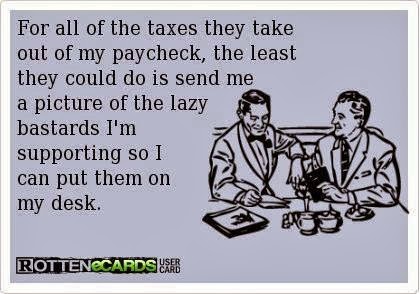
I got started on this line of thought when the following graphic landed in my Facebook feed. 


I'm sure the person posting this simply thought it was funny, but the implication that his tax money goes to welfare and that the people receiving assistance are “lazy bastards” is far from funny. To take an entire segment of American society and arbitrarily accuse them of being lazy and bastards is simply hateful. 

We have all heard the stories of leaches unfairly bleeding the system, but the fact remains that an overwhelming number of those accepting assistance are simply down on their luck. The greatest number are children. The humanist in me cares less about a few leaches bleeding some small amount from my tax dollars than I care about helping the ones in need. 

The notion that tax money is "supporting" anyone seems a bit of an overstatement, since the allowable benefits are so small. I did a little research to see just how much of my tax money actually went to welfare, and what the documented rate of abuse might be. 

The first data I discovered tells us that SNAP fraud is at an all-time low, estimated at just 3% of the total allotment. So the waste and abuse meme is simply a myth. 

Further research provided data on how much of our individual tax bill actually goes to welfare. The amount that SNAP costs when spread over the entire population is only slightly more than the average wage earner spends in a week just for lunch and coffee. 

If you are like me... pretty much just an average working stiff... you probably paid somewhere between 18% and 22% of your 2012 income in federal taxes. For me that was about $1,200. 

Under current law about eight cents of each of my tax dollars is designated to some non-military welfare fund. In other words I contributed just under $100 toward those hated “entitlement” programs. Programs that are helping underprivileged and disadvantaged members of our human tribe… giving them a chance to sustain themselves until they can gain a foothold and start contributing back to the society that gave them a helping hand. 

As I have already admitted, I know there there are leaches sucking the government tit and taking advantage of my small largess, but as a humanist I’d far prefer to see a Cadillac driving slug in Wal-Mart buying cigarettes and potato chips with food stamps than I would see a down on her luck single mother or her child miss a meal and lose the chance to claw her way back to self sufficiency. 

I really wish that otherwise bright people would do a little background checking before posting these hateful memes or making such bigoted statements. It is almost as if they have minds already made and purposely avoid any data that might demonstrate their position flawed. Regrettable, especially when such drivel comes from someone I call friend. 

As a sidebar, for every cent of my taxes (yours too) going to welfare there are about five that go toward supporting us when we get older and retire. Another four cents goes to the Pentagon’s budget. If you want a photo of what your taxes support I can send you one of an old fart in Bermuda shorts, Hawaiian shirt and Panama hat standing in front of a B-1 bomber. That could be you or me if we are fortunate enough to survive that long, and I certainly don't want to see a part of my retirement that I have paid into and supported all these years disappear simply because a few people refuse to check the facts and choose to remain ignorant.

The breakdown for how tax dollars are spent is roughly this: 

  • 24 cents to military, defense and veterans programs
  • 16 cents to Social Security
  • 16 cents to Medicare
  • About 10 cents to interest on the debt
  • About 8 cents to the classic “welfare” programs, including food stamps
  • 6 cents to public health and disease prevention
  • 4 cents for infrastructure, transportation, highways and bridges
  • 3 cents for unemployment assistance and job retraining (the fellow who posted the above graphic should know a little about this part)
  • About 3 cents for education
  • 2 cents for natural resources
  • 2 cents for federal pensions and the general running of government
  • 2 cents to “foreign aid”
  • About a penny for disaster aid
  • About a penny to the court system and federal prisons
  • Less than a penny to commerce and housing
  • Less than a penny to science and research
  • Less than a penny to agriculture 

So instead of chiseling poor people out of the few dollars they get from the social programs, why don’t we chop the eight cents off of the Pentagon’s budget. We ought to be able to accomplish that since we already outspend the next eight big spending countries combined. If we were to slice a third of the defense budget we’d still outspend the next five combined.


The point to all of this is that people aping these hateful memes should pause a bit and check facts before blindly accepting them to be factual. Almost all of these are rooted in bald-faced lies and distortions and are composed by people with fear and hate in their hearts. Almost all of them are forwarded by people who have a belief and do not want that belief challenged... so they don't check them.

If you are so easily manipulated that you don’t mind blindly forwarding hateful lies, you live in a very small world indeed. 

###

September 5, 2013

Flawed Reasoning and Failures in Cognition, the wrap-up

 - Part 3 of 3

Over the past couple of days we established the negative outcomes resulting from confirmation bias and the resulting flawed reasoning. We further defined some of the fine subdivisions of confirmation bias. Today define a few more of those subdivisions and wrap up our discussion.

Bandwagon Effect might also be called the “mob effect” or “mob behavior”. While we are often unaware of it, humans have a strong tendency to go with the flow. When the masses start to pick a winner or a favorite, that's when our individualized brains start to shut down and enter into a kind of "groupthink" or hive-mind mentality. But it doesn't have to be a large crowd or the whims of an entire nation; it can include small groups, like a family or even a small group of office co-workers. The bandwagon effect is what often causes behaviors, social norms, and memes to propagate among groups of individuals — regardless of the evidence or motives in support. This is why opinion polls are often maligned, as they can steer the perspectives of individuals accordingly. Much of this bias has to do with our built-in desire to fit in and conform, as famously demonstrated by the Asch Conformity Experiments.

Projection Bias makes it difficult for us to “walk a mile in their shoes”, to project outside the bounds of our own consciousness and preferences. We are trapped inside our own minds and for this reason we mistakenly assume that most people think just as we do… often with little or no justification. This cognitive shortcoming often leads to the related effect of false consensus bias where we tend to believe that people not only think like us, but that they also agree with us. It's a bias where we overestimate how typical and normal we are, and assume that a consensus exists on matters when there may be none. This can also create the effect where the members of a radical or fringe group assume that more people on the outside agree with them than is the case. Or the exaggerated confidence one has when predicting the winner of an election or sports match.

The Current Moment Bias is the “things will forever be as they are now” bias. Humans find difficulty in imagining our future selves and resist altering current behaviors and expectations accordingly. Most of us would rather experience pleasure in the current moment, while leaving the pain for later. This is a bias that is of particular concern to economists (i.e. our unwillingness to not overspend and save money) and health practitioners. A 1998 study showed that, when making food choices for the coming week, 74% of participants chose fruit. But when the food choice was for the current day, 70% went for the chocolate.

Anchoring Effect, also known as the Relativity Trap, is the tendency to compare and contrast only a limited set of items. It's called the anchoring effect because we tend to fixate on a value or number that in turn gets compared to everything else. The classic example is an item at the store that's on sale; we tend to see (and value) the difference in price, but not the overall price itself. This is why some restaurant menus feature very expensive entrees, while also including more (apparently) reasonably priced ones. It's also why, when given a choice, the larger number of us will pick the middle option… not too expensive, and not too cheap.

Rebooting

Spend a bit of time, if you will, in some self-analysis. Looking at these definitions and comparing them to your own perspectives, how often do you find yourself guilty of feeding personal biases? Look at your friends. How many of these have political or religious beliefs mirroring your own?

The most passionate will recognize flaws in cognition only in those whom they oppose… and will never admit that they too might be viewing the world through glasses tinted by bias. The truth is that all humans are subject to the bias traps and the sooner we recognize the flaws within ourselves within… the quicker we will be able to adapt.

Adapt we must. We find ourselves in already very polarized positions and suffering from the political divides in which such polarization inevitably results. Both the far left and the far right can be observed lumping any position more centrist into the far opposing camp. Thus we hear the acronyms “RINO” and “DINO” casually bandied about.

The truth is that both extremes have abandoned reason and neither can recognize the danger in such posturing. The reasonable must self-diagnose these failures and debug our systems. There must be enough reasonable voices to outvote and overwhelm passionate partisanism. There is truth to be found in every perspective and good can come even from some of the more extreme views, but both extremes must also learn that the final adaptation will be in the drift back to the center. 
REV: 20130831-0500
###


H/T to George Dvorsky

September 4, 2013

Flawed Reasoning and Failures in Cognition, continued

 - Part 2 of 3

Yesterday we established confirmation bias as being at the root of our failure to reason logically when debating political and religious divisions. Today we will discuss textbook definitions for some of the subdivisions within the umbrella we call confirmation basis.

In-group Bias is a somewhat nonspecific bias of genetic origin. It is rooted deep in our animalistic or tribalistic tendencies, manifesting as the fear and hatred of people “not like us.” Research has shown this bias may be affected by the neurotransmitter oxytocin. University of Amsterdam psychologist Carsten De Dreu describes oxytocin as helping us forge bonds with the people of our in-group while having the opposite function for those on the outside. It promotes suspicion, fear and even hatred of the out-group.

This particular bias is evident in both political subdivisions and religious theology, causing individuals to discard those not within the subdivision or sect while elevating inbred and possibly deficient individuals to positions of leadership. Where it hurts us is that it leads to an overestimation of the value of our fellow tribesmen while diminishing that of people we don't really know, often resulting in a terrible waste of talent.

Observational Selection Bias is when we suddenly start noticing things we didn't notice that much before, and then incorrectly assume that the frequency has increased. An example might be pregnant women suddenly noticing a lot of other pregnant women, or new car buyers suddenly noticing the same car everywhere they look. The likelihood is that there really isn’t any increase in the frequency, but instead the thing has become elevated in our mind and in turn we notice it more often. Trouble is that most people don't recognize this as a selectional bias. Most actually believe these items or events are happening with increased frequency, causing a distinctly disconcerting feeling. Another attribute of this bias is that it contributes to a feeling that this couldn’t be coincidence.

Status-Quo Bias promotes the human tendency to be apprehensive of change and often leads to choices that guarantee things will remain the same or change as little as possible. This has obvious ramifications in everything from politics to economics. Take for instance the difficulties of the 60s experienced by those pushing for racial equality, and the subsequent resistance still evident 50 years later. More recently there are the LGBT issue and continued support for marijuana prohibition.

We like to stick to our routines, our political parties, and even our favorite restaurants. When given the choice between the unknown Bob’s Diner and the familiar Burger King, status quo bias prompts a fearful resistance to the unknown and often prompts the choice of the latter.

The perniciousness of this bias is the unwarranted assumption that another choice will be inferior or make things worse. We know that the Burger King will serve something familiar, even if perhaps not of the highest quality or with the best flavor. Although Bob’s Diner might have far better food, the risk is more than many will take. The status-quo bias can be summed with the saying, "If it ain't broke, don't fix it"… an adage that fuels conservative tendencies. And in fact, some commentators say this is why the U.S. hasn't been able to enact universal health care, despite the fact that so many support the idea of reform.

Negativity Bias is the belief that all news is bad news. People tend to pay more attention to bad news… and it's not just because we are morbid. Steven Pinker, in his book The Better Angels of Our Nature: Why Violence Has Declined, argues that crime, violence, war, and other injustices are steadily declining. Recent national crime statistics tend to verify this, yet most people would argue that things are getting worse. An example is the constant drumbeat that the U.S. economy has steadily gotten worse under the current administration, when all reliable data proves this to be untrue.

Social scientists tell us that we perceive negative news as being more important or profound. We also tend to give more credibility to bad news, perhaps because we are suspicious of proclamations to the contrary. In our prehistoric past the heeding bad news may have been more adaptive, but today we run the risk of allowing this bias to inhibit growth. Dwelling on negativity at the expense of genuinely good news tends to cause people to believe that the world is a worse place than it actually is.

Some who voted for the current President are experiencing Post-Purchase Rationalization bias. This occurs following what starts out looking like a good deal, but later seems a bad bargain. The same occurs when we see something in a store and just can’t live without it. We take it home and later find the gee gaw not as valuable as we first thought, causing us to start doubting our decision. We might regret the purchase because of the expense or because it did not perform as expected… but then the bias kicks in and we convince ourselves that it was a smart move regardless of the deficiencies.

This is the mental mechanism that causes us to feel better after we make poor decisions. It provides us with a way to subconsciously justifying our decisions. Psychologists call this the Dissonance Model of Post-Decision Product Evaluation, and describe it as stemming from commitment principle and need to avoid the state of cognitive dissonance.

Neglecting Probability bias stems from irrational fear of low probability threats. An example would be the fear of flying. Almost nobody is afraid of riding in a car, but a measurable demographic refuse to fly out of fear of crashing. Many others suffer elevated stress levels while flying. This in spite of the fact that automobile accidents account for at least 67 times more deaths than air crashes.  Some estimations show the odds to be considerably greater even than this.

Now compare this with the current, rampant fear of terrorist incidents. In the U.S. you are far more likely to die of cancer than by terrorist attack, yet the anti-terrorism budget expends on average a half million dollars per documented victim of terrorism on an annual basis, while the budget for cancer prevention lays out only about $10,000 per victim.

The phenomena represents the human brain’s failure to grasp proper sense of peril and risk. It leads to the overestimation of risk for rare events while underestimating the risks involved with the more familiar yet far more dangerous. This country is currently suffering from an almost hysterical fear of terrorism, even though the odds of choking on your food or becoming accidentally poisoned are far greater. If society wishes to effectively counter the actual dangers we face, we must first put them in perspective.

Gambler's Fallacy or Positive Expectation Bias is perhaps more like a bug in our software than a bias. We inexplicably put tremendous weight in previous experience and let this influence our expectations. Think about flipping a quarter. If one flips heads four or five times in a row we are inclined to believe (and to bet on) the likelihood that the next flip will be tails. As Spock might say, this is illogical. The odds remain the same regardless of previous outcomes. The outcome of each coin flip is statistically independent of previous results, meaning the probability remains 50-50.

The positive expectation is that luck must eventually change and that because of all the previous bad luck it must mean that it is our turn to win. Successful gamblers know this not to be a valid assumption and do not rely on luck. These people have the ability to tabulate previous events, maintain the current odds in their heads and only bet when those odds are favorable. They also have an ability to “read” people, and can be pretty accurate in judging a bluff. This is not luck… it is science.

Further discussion and the conclusion of this thesis will continue tomorrow.
###

September 3, 2013

Flawed Reasoning and Failures in Cognition, part 1

 – Part 1 of 3

The most powerful computer of which we are aware is our own human brain. The ratio may have recently changed with the introduction in Japan of the K computer, but previously it was determined that our brains have the capability of 1016 processes per second. Powerful our brains may be, but humans are handicapped by a variety of quirks, bugs and self-imposed limitations.

The five-buck calculator sold alongside candy treats and novelties at the discount store checkout has the ability to process math to an exponentially higher degree than the average human brain, and we suffer from a deeply flawed operating system that mishandles memory and is highly susceptible to malware. Our mental data filters and filing systems are screwed up more so than even Microsoft’s “Bob”. We are prone to cognitive biases that frequently produce grossly erroneous assumptions and result in truly questionable decisions. Worst of all is our seeming inability to self-diagnose and correct these errors.

So why is that dime store calculator perhaps superior to our brain, at least in functionality? Unlike the processors in our mechanical counterparts, the human brain is lazy. This laziness is hurting us, resulting in deep political and social divisions. Mental biases make conclusion jumping and stereotyping the norm rather than the exception. As a collective we often engage in highly self-destructive behavior that we justify by repeatedly leaping to false assumptions. Our mental behavior fails the rationality test. We should work on that.

Perhaps a starting point for any correction would be to better understand the areas of the human psyche where aberrant traits reside, followed by subjecting our faulty circuits to critical examination. While most of us lack the education and training to make hardwired changes, we can at least look at the behavior and try to avoid the pitfalls.

We could start by defining and demonstrating the difference between cognitive bias and logical fallacy. Both are easy pitfalls that result in a misunderstanding of the world, but these two are very different from each other. Logical fallacy may be defined as errors in logical argumentation. Although some argumentative fallacy is premeditated, most logical errors result from cognitive laziness. The logical fallacies are well described in textbooks and taught in debate class starting in our high school years. Anyone with even a basic secondary school education is aware of the trap, but for some reason the ability to avoid them appears mostly beyond the capacity of modern man.

Social media is quite revealing when it comes to the demonstration of failures in human logic. Perhaps the most common transgression is the use of ad hominem. Simply put this is when we attack the person rather than the philosophy; the messenger rather than the message. Although certainly not exclusive to political discussion, that element of human endeavor is rife with personal attacks.

There is no better evidence of this than the opposition to President Obama. A rather significant segment of the opposition behaves as if anything this president manages to accomplish takes a back seat to the “fact” that he is a foreigner, or a communist, a Muslim, or socialist… or any number of faux scandals.  The amount of energy, time and money expended on fruitless efforts to prove that Mr. Obama wasn’t born a U.S. citizen has been tremendous and extremely wasteful, both in terms of dollars and in the deep social divisions. The opposition appears not to care about the price and continues to recycle disproven memes on a regular basis.

This line of political attack incorporates both logical fallacy and cognitive bias, with one feeding off of the other. The political right wing is predisposed to dislike the Democratic Party because of deep rooted bias, and vice versa for the left. Directed at the current administration there are all those fear-inducing boogyman words mentioned above; socialist, communist, Muslim and foreigner, but perhaps the real culprit is the cognitive bias. For the demographic that does not like the President, no amount of contrary evidence will alter that bias.

Contrasting logical fallacy with cognitive bias we find something that is more innate and subconscious. The cognitive bias is a genuine deficiency or limitation in our thinking… a flaw in judgment born of errors in memory, social attribution, and mental calculation. Psychologists and social researchers have described our cognitive biases as helping us process information more efficiently, especially in potentially dangerous situations. Perhaps, but they can also lead us into making disastrous mistakes.

While we may be prone to these errors in judgment, we at least can make ourselves aware of the flaw. As you read the following definitions try to relate them to areas of your personal, political and social life. I’ll take a little time to describe my understanding of some of the more general biases and relate them to personal experience.

Confirmation Bias
Behavioral psychologist B. F. Skinner coined the term “cognitive dissonance”, which is to unconsciously or subconsciously access our mental filing system… selectively searching only for perspectives that feed preexisting views while at the same time ignoring or dismissing any bit of information, regardless of validity, which fails to agree with those views. It is this dissonance that is at the root of the bias.

Confirmation bias promotes an attraction to people who agree with us while allowing us to justify the “un-friending” of those who disagree. It makes us lean toward reading, watching and listening to news and visiting websites with content confirming what we already believe. That this favored source may be omitting contrary data or even fabricating false data is something we will acknowledge only when cornered. Until then we will defend the source and employ the “evidence” in our attacks.

Confirmation bias pushes us to be selective in choosing friends, tending to associate mostly with people who hold similar views and tastes. We find individuals, groups, and news sources that make us feel uncomfortable or insecure about our views to be off-putting.

Taken to the extreme these individuals will refuse to listen to a contrary opinion even when graphically demonstrated, but will make positive yet baseless statements based upon incorrect information absorbed from the agreeable sources. An excellent example would be recent objections voiced against the CSCOPE curriculum tools used in many Texas public schools… both public and private. Texas Senator Dan Patrick (R) (who is running for lieutenant governor in the 2014 elections) has made it his mission to ban the curriculum. Sen. Patrick heard from some of his supporters, religious right-wing activists, that the CSCOPE lesson plans are “Marxist, anti-American and pro-Islamic.” That information is distorted and untruthful as can be seen by accessing the lesson plans (they are in the public domain), but this made no difference, as Sen. Patrick.

Sen. Patrick has his mind made and is not interested in veracity. His only interest is supporting his bias. The proof of this has finally surfaces. After months of stating with authority that the CSCOPE lesson plans are evil and “of the devil”, Sen. Patrick now admits he has never read the lesson plans. This has not changed his mind and Sen. Patrick remains single-mindedly focused on his misguided mission.

The problem with such dramatic bias is that we limit our ability to locate and process new information, often to our own detriment. Humans suffering from this disability are prone to believing that their worldview is correct and tend to accuse others of failure to understand the real truth. Religious apologists and anti-vaccine activists are also representative of this bias.
 There are many subdivisions of confirmation bias. I’ll detail a few of those over the next few days:
###

August 24, 2013

Past Lessons Remembered


“…we know without a doubt that Republican ideas of more freedom and less taxes — while sounding good and repeated by any and all candidates – are in fact, worth no more than the paper that they are written on.”

These are words written by 13 life-long members of the Maine Republican Party… officials within the party… as they resigned that membership and walked away from the former Grand Old Party.

In the letter (full text below) dated August 18, 2013, the former Republicans outline many of the same grievances expressed over the past several years by this writer. The defectors feel that the party of their fathers has lost sight of the goal; that there is an element within the modern GOP that has forsaken the true meaning of conservatism and steered the party into the netherworld of bigotry, divisiveness, social engineering, irrational spending and blatant unconstitutional actions. 

That last sentence at one time described Southern Democrats… The Party of Jackson... but those roles reversed shortly after Jack and Bobby Kennedy went to Washington.

The campaign for the Presidency in the waning years of the Eisenhower Administration illustrated all to well a schism within the Democrat Party… with much of the divisive rhetoric emanating from Southern Democrats. Jack Kennedy was Catholic, and there had never been a Catholic elected to high office. The last one to try was Al Smith in 1928. Fear mongers mindlessly and endlessly promoting the trope that the Pope would be running the White House if Smith won proved effective. Southern Democrats sat out the election and Smith was crushed… Hoover took the White House and the nation sunk into the Great Depression. The only winner in that election was bigotry.

32 years later another Catholic found himself fighting the very battles that sunk Al Smith. The dirty tricks weren’t as effective this time and Mr. Kennedy went on to win the Presidency in the closest election in history. Mr. Kennedy won 49.7% of the popular vote to Nixon's 49.5% with Kennedy polling only about 100,000 more votes than Nixon out of over 68 million votes cast. Nixon won more states than Kennedy but the Electoral College awarded the election to Kennedy by a 303-219 margin. The only southern states not called for Nixon were Mississippi and Florida. Anti-Catholic bigotry is blamed for a million and a half lost votes.

Three assassinations, two paradigm changing bills, an impeachment leading to the only resignation of a sitting president and a whole bunch of cross burnings later finds the freedom loving folks of the U.S.A. still fighting the battles of social injustice and fiscal conservatism. The political party names and the memes spouted haven’t changed, but the demographic certainly has. The once fiscally conservative GOP still proudly wears the mantle of conservatism, but has forgotten what that word really means. Many of those calling themselves Democrat still shout for social justice, but their actions seem more inclined toward social control.

Where once the southern bigots were the tail wagging the Democrat’s dog, following a decade of country-shaking events they abandoned the Democrats for the GOP. The Party of Eisenhower became infested with the parasites of the Party of George Gordon and John Clinton Porter.

Those of us in the middle… moderates yearning for a day when the search for social consciousness, constitutional justice and conservative fiscal policy can be balanced by compromise… find ourselves politically homeless.

Of the two available options, some choose simply to check None of the Above, but is that a logical option? The pragmatist’s answer is a resounding NO! Opting out and wasting a vote may make a valiant statement, but it solves no problem. The only real solution is to hold nose, vote for a candidate with whom one cannot 100% agree because that candidate represents a less oppressive path, and then work from within to weed out blind partisanship and taking a stand against hatred, bigotry and divisiveness.

The promise of Eisenhower conservatism has been lost in the swill of religio-political rhetoric, as the modern GOP has become the spend-spend-spend party of no compromise tirelessly struggling to elevate the almighty corporation to the tyrannical level we see today. Damn near every major Republican effort since the McCarthy/Nixon era has concentrated on things and people of which we should be afraid, why we should hate certain elements within our own house, constantly starting wars justifying the need to give more money to the defense industry corporatists.

Every Republican Administration from Reagan through George W. Bush has dramatically increased the war budget, increased the deficit and pushed the country into further debtor status, yet the echo machine perpetuates the myth that the Democrats are the party of tax & spend and the meme that the deficits created by their own party are actually the responsibility for the Democrats. Facts prove this to be a lie, but corporate puppets never let facts get in the way of a good myth while blinder-wearing sheep wag tail and follow.

Last month a Pew study found 54% of self-identified Republicans believed that the GOP should “move in a more conservative direction” and 35% feel that Republicans compromise “too much” with Democrats. Less than half of GOP voters, 40%, say they feel the GOP should become more moderate and 27% felt their party hadn’t compromised with Democrats enough.

The reason we are seeing high profile defections from the GOP is represented by that poll. No reasonable human can fail to notice the blinders of a demographic a third of which believes Republicans compromise “too much”.

Further evidence of the blindness endemic in the GOP herd was evidenced in the results of a Public Policy Poll of Louisiana residents in which a greater number of respondents blamed Barak Obama for the poor response to the hurricane Katrina disaster than blamed George W. Bush.

The full text of the letter referenced above follows. Emphasis I've added it to illustrate where I find agreement. My more liberal friends will likely take issue with the fact that I agree with them on the gun legislation and that the FDA sometimes oversteps, but if so you need to understand that being a moderate means supporting our Constitution, regardless of emotion. 

August 18, 2013

To Maine State GOP Secretary Chuck Mahaleris:

There are times in your life when you must choose between two paths.

The first path, if taken, would require us to remain within the Republican Party despite the fact that we know without a doubt that Republican ideas of more freedom and less taxes — while sounding good and repeated by any and all candidates – are in fact, worth no more than the paper that they are written on.

The second path leads to a principled preservation of our individual integrity, helping out our fellow citizens at the local level, and doing our level best for our Creator, our families, and our friends.

We have therefore chosen to follow the path of the latter.

Effective immediately, we the undersigned are unenrolling from the Maine Republican Party. Furthermore, those of us who hold official Party positions, be they at the Republican National, State, County or even Town Committees, hereby resign. Our reasons for doing so are as follows:

The RNC:

At the RNC, we have fought the good fight and kept the faith with regards to the rules. The Resolution that was passed in January 2013 by the Maine Republican State Committee put the RNC on notice that the grassroots were listening (and watching), leading to the rules battles which have taken place consistently since the 2012 Republican National Convention in Tampa. The duplicity and lack of political courage which has been on display in this matter has sealed the fate of this Party.

Furthermore, it has become clear to us now that the RNC has no intention of reforming and would rather fly under invalid rules than to right the wrongs of Tampa. We therefore cannot, in good faith, support or defend the actions of the RNC. To violate our consciences and support those actions would make us part of the problem – especially after we clearly provided and handed the RNC the solution which was flatly rejected. The RNC now owns their demise.

Congressional Republicans:

In the House of Representatives, the cowardly leadership of John Boehner reached a new low in December 2012 when he purged the most fiscally conservative GOP members from leadership positions, citing their “unwillingness to be team players.” Political punishment such as this from Speaker Boehner has garnered justifiable rage from conservative groups, and from us, as we expected better.

Furthermore, the House Republican leadership’s utter disdain for the United States Constitution, specifically the 4th Amendment, was on full display as they worked overtime to kill the Amash Amendment which would have gone a long way toward constraining the NSA to the boundaries of the Constitution and seriously curbed their ability to conduct mass surveillance of Americans. Be it known that we cannot and will not support nor defend these actions.

In the United States Senate, we see Republicans all too willing to pass unconstitutional bills related to subjects such as the Internet Sales Tax and Immigration. Whether through arrogance or ignorance, they fail to understand the simple fact any revenue generating legislation must originate in the House of Representatives.

Additionally, the Senate Republicans continue to support undeclared wars, meet in secret and supply arms to our “terrorist enemies” who we vowed to destroy after 911, and then tell us they love our troops – so long as it’s our kids and not theirs who have to go fight.

Lastly, all too many Senate Republicans are more than willing to pass new “feel good” gun control legislation that would do nothing to stop another Sandy Hook massacre, all the while restricting 2nd Amendment rights of law abiding American citizens. We cannot support nor defend these actions in good faith.

Maine Republican Legislators:

In Maine, the Republican legislators in the House and Senate failed to sustain the Governor’s veto on one of the most important pieces of legislation of the 126th. Maine Republicans were justifiably outraged, especially at those legislators who campaigned on lower taxes.

We have been told that many donors have refused to donate one more cent to the MEGOP due to this budget debacle, but nevertheless we are expected to ignore these facts and get out there and raise funds for the party. This we cannot do in good faith; the Republican Party has lost its way and the donors know it.

The LePage Administration:

Not to be outdone by the legislators, this Administration’s support for Common Core Education Standards, the Internet Sales Tax, the atypical meddling in the business of the Maine State Committee, as well as the vetoes of the Drone and Cell Phone bills left many of us incredulous.

However, the straw that broke the camel’s back for many of us was the veto of LD 1282 (the “Raw Milk Bill”) and those who voted to sustain it: a sad day indeed for the small farmers of Maine. We want our God-given rights to buy, sell and consume what we want protected by the law – not restricted by FDA or USDA directives. These actions we cannot explain nor defend in good faith – the Republican Party has lost it’s way.

Therefore, for the above-stated reasons, we can no longer allow ourselves to be called nor enrolled as Republicans; we can no longer associate ourselves with a political party that goes out of its way to continually restrict our freedoms and liberties as well as reaching deeper and deeper into our wallets.

We instead choose the path that focuses on ways to help our fellow Mainers outside of party politics.

Some of us may be town officers or board members. Some of us may leave all options on the table with regards to running for higher office as Independents.

Some of us may be small farmers and gardeners who desire to help feed their communities.

Others may simply want to just get part of their life back, catching up and spending more time with friends and neighbors.

Sincerely,

Republican National Committee Member:Mark Willis, Washington County

Maine Republican State Committee Members:Thomas Barry, Androscoggin County

Ann-Marie Grenier, Cumberland County

Gregory Hodge, Lincoln County

Olga LaPlante, Cumberland County

Russell Montgomery, Knox County

Violet Willis, Washington County

Maine Registered Republicans:

Sam Canders, Penobscot County

Bryan Daugherty, Penobscot County

Maria Hodge, Penobscot County

Randall J. Grenier, Cumberland County

L. Scott D’Amboise, Androscoggin County

Debbie D’Amboise, Androscoggin County


###