February 24, 2020

While Decent White People Were Sleeping, The Bigots Stole America


Author John Pavlovitz 
Published 16 February, 2020


It’s morning in America. 

A lot happened while we were sleeping. 

This is not the America we thought existed back in November of 2008—likely the last time many of us were fully awake. 

Back then, we basked in the warm glow of the reality of a black President and we grew comfortable, nestling down into a complacency that only the blind spots of privilege and false information provide. 

The joy of that moment became a slow-acting emotional sedative that slowly squeezed out the urgency from us; one that gradually dulled our senses, that day by day numbed our minds into imagining we had arrived together at Martin’s glorious mountaintop. If we had taken the time to ask vulnerable people, they’d have told us not to fall asleep. 

Believing that the aspirational “we shall overcomes” that once rang out, were now a fixed and unchangeable present, we settled cozily into that place where the heart rate slows and the limbs and eyelids grow heavy—and where without realizing it, slumber suddenly overtakes you: 

one blink awake, the next blink asleep. 

And for eight years we sleepwalked through the world, physically here and moving through daylight but not fully present, not totally seeing—caught between the actual and the unreal world, between the real nightmare and the imagined dream. Yes, we still talked and marched and campaigned and worked, but we did so slightly sedated in the haze of bad stories, willful ignorance, and wishful thinking. 

Meanwhile, the bigots woke up. 

Shaken violently from sleep in November 2008, by the reality of what decades of fear and terrible theology taught them was the absolute worst place they could find themselves—they began to mount a fierce counterattack. 

They created news outlets and social media platforms designed to filter out everything except that which would fully trigger terror within the hearts of their intended targets and would-be allies: 

fantastical stories of a pervasive and coordinated Gay Agenda coming to convert their children; 

of violent, heavily armed, brown-skinned drug gangs overrunning our borders; 

of godless, abortion-mad progressives having indiscriminate sex without fear or care; 

of Muslim terrorist hordes infiltrating our neighborhoods and bodegas; 

of America-hating Democrats coming for their jobs and flags and prayers and guns. 

And we were still sleepwalking… 

They leveraged thousands of Christian pulpits, where every seven days they’d wildly stoke the fires of people’s phobias and fears, weaponize the Scriptures against gays and migrants and Muslims, pervert the expansive Gospel of Jesus into rabid nationalism—and sermon by sermon, enlist them all into service as passionate soldiers in the Army of the straight, white, American, male Lord. 

And we were still sleepwalking… 

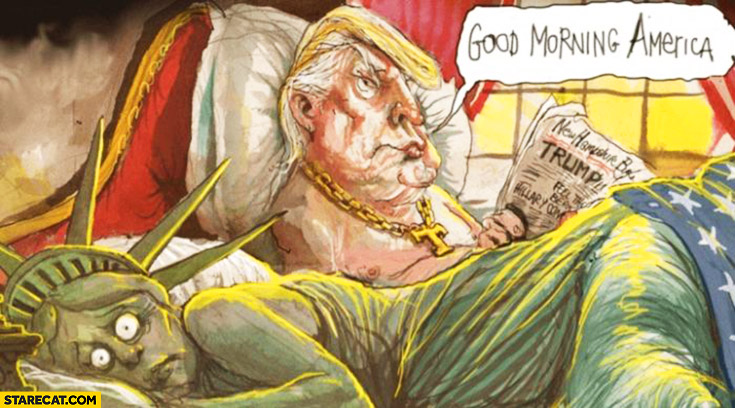
Then, to inculcate the terror fully, they propped up a sideshow carnival barker as their chosen one; a barren, empty husk of a man with no discernible moral convictions beyond wealth accumulation—who they could use as a flesh and blood avatar to embody and perpetuate themselves. 

They fashioned a vile, blustery orange idol to rally the fearful and the angry and the callous hearts around; one who would daily dig into the stinking muck to find a deeper bottom—and in the sleep-induced state we were in we thought it was a joke. We laughed ourselves back into a dreamworld where everything would be fine and where decency would prevail and where the system would work; so much so that one hundred million of us slept all the way through an election cycle. 

And here we are. 

I wonder if we’re fully awake now. 

I wonder if we’re ready to cast off the cobwebs of our complacency and enter fully into the bloody fray in front of us. 

I wonder if we’re willing to rouse ourselves into lucidity and step into the jagged trenches of the fight of our lives and for the disparate swath of humanity who we’ve let down. 

I wonder if we’re prepared to face our culpability and admit our failures and make amends with our time and our resources and our votes. 

Or maybe we’ll just find another way to anesthetize. Maybe we’ll self-medicate on social media and reality TV and two-for-one happy hour specials and puppy photos on social media, and again retreat into the comfortable places and once more grow so sleepy that we’ll nestle back into slumber. 
I wonder if there’s still time to undo the present nightmare. 

The only way we’ll have a chance to know is if we wake up and stay awake. 

It’s morning in America. 

There’s mourning in America. 

Rise and shine. 


~~~ 

October 13, 2019

The Sounds of Silence

The meanings hidden within the words...

Paul Simon wrote Sounds of Silence when he was just age 21. I was age 11 at the time and fell in love with the song. It didn't at the time occur to me just how amazing it was that one as young as Paul Simon should have such intrinsically deep understanding of interpersonal communication, yet he has shown his depth of mind in almost everything he has written.

Those first few words... “Hello darkness, my old friend...” seem to speak of an introverted and lonely human. Simon is telling his story... or perhaps the story of someone very close to him. Those few words tell the story of someone more comfortable being alone in the night than in the glare and noise of the city... an unknown and perhaps unrecognized child speaking. The lonely child who has grown into adulthood. But I've always wondered if that was really what it meant, or was he saying something else entirely.

Doesn't that song fit so perfectly with this day, when our world has become so noisy and intrusive? So damn vulgar. I can't remember a time quite like this. Not the Cold War, not Vietnam, not Kent State or even the Nixon impeachment was close to what we are experiencing now. People are not talking with each other these days. They are talking at, and often shouting at each other. In the 60s we had our differences and they were stark differences too. Nothing like this though. In the 60s the argument remained political. Today we have a president openly threatening civil war if he doesn't get what he wants.

Perhaps this wouldn't be quite so frightening if it were only the U.S. president, but it's not. Would be tyrants have gained power in nations across the globe. There have been many conversations recently where someone has raised the specter of a world permanently changed. Suggesting that we will never be able to find that equilibrium that we almost had. That democracy itself has been so badly pummeled that we will have lost it. It causes me to wonder if Paul Simon was perhaps not writing lyrics for a song about the times he was seeing and experiencing, but rather that he was predicting the future.

We humans have never really tried very hard to communicate and certainly not to listen to others, but today is somehow worse than ever before. There is no longer that imperative that we should understand others. Instead we must overpower them and hold them down. Perhaps this is what Paul Simon was trying to tell us.

He's never explained the lyrics of that anthem to our innocent youth. He's just left it for us to figure out. I wonder if we will. I wonder if we can.
~~~

August 28, 2019

March on Washington Remembered

MARCH ON WASHINGTON FOR JOBS AND FREEDOM, AUGUST 28, 1963: ONE PARTICIPANT REMEMBERS

Edith Lee-Payne at the March on Washington, 1963  
Photo by Rowland Scherman, Courtesy US National Archives

In the account below Edith Lee-Payne recalls the day she was photographed as a 12 year old participant in the March on Washington, and the curious history of that photograph through 2011.
My grandparents, Marie and John Spencer Lee, left Culpeper, Virginia for Washington, D.C. in the early 1900s, where my mother Dorothy Lee was born. My mother settled in Detroit, Michigan in 1940, married William Henderson Lee in 1947, and I was born four years later.  Summer vacations were always spent in Washington.  My 1963 summer vacation, however, is forever marked in history and my personal memory, because I was there when the March on Washington for Jobs and Freedom took place on August 28, 1963.  That March, which took place on my 12th birthday, changed me and transformed the nation.
Dr. Martin Luther King’s “I Have a Dream” speech is by far the best remembered moment at the March on Washington.  King gave the speech before an audience of 250,000 gathered at the foot of the Lincoln Memorial.  With the giant statue of Abraham Lincoln in the shaded background, Dr. King described a world he envisioned as dominated by love, freedom, and justice
I heard the speech that day but I also heard one similar two months before in Detroit.  On June 23, 1963, Rev. Dr. Martin Luther King Jr. and Rev. C. L. Franklin (Aretha Franklin’s father) led a march of over 100,000 people down Woodward Avenue to Cobo Hall in downtown Detroit.  Dr. King encouraged us to join him and others in Washington, D.C. on August 28 for a peaceful demonstration that he believed would help bring attention to the injustices of segregation throughout the south. He reminded us “injustice anywhere is a threat to justice everywhere.” Convinced by Dr. King’s rousing discourse and other reasons I later learned, my mother scheduled our annual summer vacation so we could attend the March on Washington while celebrating my 12th birthday.
Both in Detroit and Washington, Dr. King used the refrain “I have a Dream.”  Detroiters still contend the “I Have a Dream” speech made famous in Washington, D.C., was actually given first in Detroit.  We already lived the dreams Dr. King envisioned for all Americans across the nation, particularly in the south.  My neighborhood, on Detroit’s northwest side, was racially integrated.  The schools I attended, Wingert Elementary and Condon Jr. High, were integrated.  Our family church, Carter Metropolitan Christian Methodist Episcopal, was integrated and included interracial families.  My mother and I dined at restaurants, sat at lunch counters served by white and/or black waitresses, without incident. We drank from water fountains without signs distinguishing “color.”  My mother never learned to drive so busses and cabs were our primary mode of transportation, also without concern of any consequence or incident.
It was inconceivable to me to know that people who looked like I did, and separated from Detroit by a few hundred miles, suffered such horrific experiences and limitations in their daily lives and often risked death.  Cross burnings, beatings, lynchings, and murders were incidents reported regularly in the periodicals my mother subscribed to including Ebony and Jet magazines and Detroit’s Negro newspaper, The Chronicle.  Mississippi Civil Rights activist Medgar Evers was one of many lives tragically sacrificed just months before the March on Washington.  Even at 11, I knew that young people like me were risking their lives to participate in demonstrations in Birmingham and elsewhere across the South for the freedoms that were part of my daily life.  I came to realize that what I learned in school about the Constitution, the Emancipation Proclamation, freedom, and opportunity, led me to question the validity of these documents and concepts.  There were no exceptions in these documents allowing these dreadful experiences to happen, yet they did.
It appeared to me that a million people converged on the Lincoln Memorial in Washington, D.C. that hot, humid day in August.  Busses marked with names of cities from across the country endlessly lined the streets.  Dr. King’s message of non-violence, resistance against segregation and discrimination came through clearly again in his “Southern preacher” voice that I first heard in Detroit two months earlier.  The March in Detroit was a testament to the peaceful demonstration Dr. King referred to as thousands of people assembled in support of the civil rights struggles in the South.  This March on Washington included not only people in support of the civil rights struggles, like my mother and I, but the people who aspired for the freedoms and privileges they were entitled to; many of whom undoubtedly suffered violence while exercising their First Amendment right to peacefully protest injustice.  This March was a testament of an entire nation of all people of every race, creed, color, and religion, standing together in the Christian spirit of love, unity, and peace.
As I listened to Dr. King and others who spoke, the simultaneous expressions of pain, anger, hurt, helplessness, despair, and hope, especially hope, was evident in the eyes and on the faces of people around me, including my mother.  Although I knew my mother was a professional dancer who shared the stage with prominent entertainers during the 1930s and 1940s, such as Cab Callaway, Billy Eckstein, Ella Fitzgerald, and Sammy Davis Sr., I learned for the first time about the injustices she encountered as she and other entertainers traveled across the South.  I overheard my mother’s brief conversation with Lena Horne where they both recalled frightening experiences and observations.  Then I realized that the tears on her face that day were not simply out of compassion for others struggling for freedom in the South, they were reminders of what she had personally witnessed and felt.
The significance of the March on Washington left an indelible memory that I appreciate with each passing year.  That day in history helped bring the enactment of the Civil Rights Act of 1964 and the Voting Rights Act of 1965 which helped make segregation and discrimination illegal and ensured millions of southern blacks access to the ballot.  Thanks to my mother, I garnered a place in history that day as well, although I wouldn’t know about it for another 45 years.
In late October 2008, my cousin Marsha phoned saying she saw a picture of me on the cover of a 2009 Black History Calendar.  She said I was holding a banner displaying “March for Jobs” and the month “August,” the only words visible in the photo.    I recalled holding a banner at the March on Washington that I still have.  Marsha described that the other images in the calendar included:  Dr. King, Frederick Douglass, Sojourner Truth, Jesse Owens, Langston Hughes, and W.E.B Dubois, and that the photos were courtesy of a museum.   Searching the picture’s origin led me to the National Archives and Records Administration (NARA) where I learned from archivist Rutha Beamon of three photos of me in its holdings. My mother is in two of the photos making them the most special since she is no longer with me.
What an incredible blessing and humbling experience that an image taken of me, captioned by the NARA, “Photograph of a Young Woman at the Civil Rights March on Washington D.C. with a Banner” has been viewed in articles, publications, and documentaries around the world.  Equally humbling, is to be associated with the greatest non-violent march in this nation’s history and with its most prominent leader, Dr. Martin Luther King Jr.  Most notably, the photo appears in the Martin Luther King Jr. Memorial brochure and the documentaries, “From MLK to Today,” by movie director Antoine Fuqua and the NARA’s “March on Washington Photographs.”
Thanks to Mark Katkov of the NARA I learned that Rowland Scherman was the photographer who captured my raw emotions on that August day in 1963.   Mr. Scherman happened to visit the NARA in the fall of 2011 identifying images of his work from the March on Washington, including the images of me.   Mr. Scherman and I plan to meet soon.
Hurricane Irene prevented the scheduled August 28, 2011 dedication of the Martin Luther King Jr. Memorial, that would have marked the 48th anniversary of the 1963 March on Washington and my 60th birthday; however, I returned to Washington, D.C. for the rescheduled celebration on October 16, 201l.  Ironically, this was my grandson Zaire’s 7th birthday.  On a pleasant fall day, busses marked with the names of cities from across the country again lined the streets of Washington, D.C. as on August 28, 1963. Attending this dedication was an opportunity to give tribute to Dr. King’s legacy, be inspired to continue his course, and reflect on that day and time.   Although Dr. King’s dreams are not yet fully realized, his tireless leadership and ultimate sacrifice to bring a nation together will never be diminished as long as I and future generations remain committed and steadfast in the pursuit of the type of society Dr. King envisioned.  We must and we will keep the dream alive.

Payne, E. (2012, February 10) March on Washington for Jobs and Freedom, August 28, 1963: One Participant Remembers. Retrieved from https://www.blackpast.org/african-american-history/march-washington-jobs-and-freedom-august-28-1963-one-participant-remembers/ 

July 3, 2019

Seems like a good time to repeat a golden oldie

Previously published. Just ran across it again and felt like it could use airing again.

Considering the ever-present political battles in which humans engage, the TED conversation by Ash Beckham struck me as particularly poignant. The point at which Ash describes events at her sister's wedding, and particularly the nervous conversation with a table full of nervous attendees, it makes me feel that I should be more tolerant of those who do not share my particular views but who honestly try to understand. Not everything has to be a battle. Everyone has a closet. It was every bit as difficult and stressful for me to step out of mine as Ash describes. How about you? Are you still in yours?

July 18, 2018

Is we smarter today than four years ago?

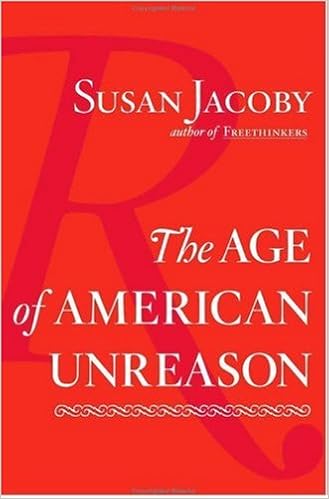
In 2004 Susan Jacoby published her book, Freethinkers, and then set out on a promotion tour. Later, when speaking of that tour she told of an interesting and important discovery... those who came to listen to her speak already agreed with the premise of the book. There was no one at any of the stops to offer dissent. It was as if those in who might be in disagreement did not care to expose themselves to viewpoints contrary to their closely held beliefs. As a result, four years later Jacoby published her next book, The Age of American Unreason. 

In that book, Jacoby observes that religious extremism and political opportunism have taken over our culture, and the means by which they have done it is by mass marketing and constant repetition of falsehood. The book is almost a sequel to Hofstadter's landmark work, Anti-intellectualism in American Life. This 1963 book was his dissection of the American mindset he had observed leading up to the 1960 election, the anti-JFK tribalism, and the segregationist attitudes so prevalent at the time. 
In her book, Jacoby writes that "the scales of American history have shifted heavily against [the] intellectual life so essential to functional democracy." When asked, she called herself a “cultural conservative,” but lamented that the term had been "hijacked by the religious right," which she describes as "preoccupied with […] the preservation of the phrase 'under God' in the Pledge of Allegiance." Throughout the book, Jacoby builds the argument that America is damaged not only by the resulting mass ignorance, but by the pride taken in that ignorance, and of the arrogance of the ignorant individuals who practically relish their know-nothingness. (“… I love the poorly educated.”) 

Ignorance is served to us daily; here in the blogosphere, on Facebook and other forms of social media, in the nightly news, the pathetic game shows and soap operas, “reality” TV programs, and every time a politician, pundit, or preacher opens a mouth. 

But there is a difference between mundane and virulent ignorance. 

Mundane ignorance is when the on-street interviewer asks a dozen passersby to point out Idaho on a map... or name the freedoms enshrined in the 1st amendment. Virulent ignorance is evident in people who claim to be educated and call themselves “stable genius.” They believe that they are informed on important subjects when in reality they’ve just been educated into greater ignorance. 

These are the people who do not show up to speak with Susan Jacoby, because they are already convinced that she is wrong. They are the people who watch only Fox, or only MSNBC for their news. They are the ones constantly parroting "fake news." They are willing to swallow falsehood so long as it agrees with what they want to believe... and they are immune to actual evidence. 


~~~